Lady hailed from Hannover, Niedersachsen formed in 1974 by ex-Jane keyboard player Werner Nadolny. Their single “Without you” and “On the Road” gain minor success back on 1976 the year they release their self-titled album featuring pomp-rock not that different from the parent group with a progressive touch in some parts. Strong songwriting and outstanding melodies compose this rarity. At the end of 1976, Grossmann and Zaake quit and were replaced by Matthias Jabs (later with Scorpions) and Rob Perotti. The band was active till 1982.
Tracks
1. Midnight Mover - 4:28
2. Give Yourself a Chance - 4:42
3. Without You - 3:24
4. Sailor (Lyrics by Corina Fortmann) - 6:12
5. On the Road - 2:54
6. World of Fantasy - 4:34
7. Sixteen - 4:27
8. Lonesome - 5:25
All compositions by Werner Nadolny, Claus Zaake, Christian Reinhardt, Hanno Grossmann
Back in the fifties, strange as it may seem, St. Louis was not a major centre for rock 'n' roll. This is despite one of the all time greats, namely Chuck Berry, being based there but seemingly he returned to his hometown to rest as opposed to performing. This left the local St. Louis scene open to various contenders, one of whom was a young and eager Jules Blattner.
He was born on 8th February 1941 as Jules Merrill Blattner and when Rock 'n' Roll music started to sweep across the nation, he soon became interested in artists like Carl Perkins, Gene Vincent, Buddy Holly and Elvis Presley as well as black acts such as Joe Turner and Jimmy Reed. Around 1956, Jules and some of his school chums from Affton High School got together and formed the group Jules Blattner & The Teen Tones. They were all so young that none of them were old enough to drive and so Jules's mum was 'volunteered' to drive them to their various performances. They played at all the local high school dances and Teen Towns, the latter being community dances for the youth. Jules recalls: Rock 'n' Roll music for many was a sound newly heard. Just being in a band made you an outlaw then. Nobody was in a band. There weren´t any where we were from. I guess we were on the cutting edge. We played every Teen Town around. And it was risqué saying "Right Now, the bands going to wee-wee," at intermission time. Woo-woo. If you caught smoking at a Teen Town, you got banned from Teen town for two weeks. You were an outcast. It was a different world. He also advises that he was the first person in St. Louis to have an electric bass.
In early 1959, the outfit came to the attention of Bob Lyons who owned the Bobbin label, a set up basically recording local artists. Bob contracted with the guys and got them into his garage studio where they recorded their own 'Rock & Roll Blues' and 'Gambling Man'. Today, these are cult classics and are much sought after, especially amongst rockabilly collectors. Billboard magazine reviewed the disc and wrote: Blattner has an okay sound on this pounding rhythm side. He has the Presley, Jerry Lee Lewis, Carl Perkins derivative quality throughout whilst Cashbox told their readers: A beat workout that is sure to please any red-blooded rock´n roll teener. Blattner and friends have lots of beat talent. 'Rock & Roll Blues' was a local success reaching the number 8 spot on the charts and position 12 on the rhythm & blues lists. To capitalise on this, in July 1959 Bobbin Records issued their second disc, 'Teen Town' c/w 'Green Stuff'.
There was almost no competition in the region and so they had as much work as they could handle. When a promoter bought a name act to town, the Teen Tones were often engaged as the opening act and also to provide the backing for the artist(s) concerned. That way, they came to work with the likes of Dodie Stevens, Jesse Belvin, Ray Peterson, Isley Brothers, Brenda Lee, Wade Clemmons, Little Richard and, in later years, Ted Nugget and Sha Na Na.
Whilst the two releases on Bobbin had been localised successes, they failed to break out nationally. Accordingly in 1960, Jules decided to try his luck with K-Ark Records, a bigger company based in Nashville, Tennessee. He cut four sides for the label, namely 'Till I'm With You', 'Lonesome', 'Lover Doll' and 'One More Time'. However, upon release, they too failed to achieve the desired national impact.
The band played a lot of fairs in the area: The fair circuit was not only very desirable because of the exposure that you could get there, it was also desirable because of the woman you could get there. Another good place to play and meet girls was the church circuit. The Teen Tones played a ton of Catholic Church dances, enabling them to get in the good with many a catholic mother!!!!. The Teen Tone Fan Club was a cool bunch of wild teenage girls crazy about that big beat sound the Teen Tones put out. These young ladies wore Teen Tones jackets to dances, hoping to be the next steady of Jules.
In the early sixties, St. Louis nightlife was centred on Gaslight Square that contained many of the area's clubs. Jules was included on an album titled 'A Musical Tour Of Gaslight Square' which was issued on Norman Records (#105). This LP featured the house band or top band from different clubs. At that time, Jules was appearing at the Butterscotch Lounge and so he recorded 'Butterscotch Twist' for the set. As the twist was then the in thing, he renamed his band The Twist Tones with that later being amended to The Jules Blattner Group. During the winter season, the guys secured a steady job playing in Hawaii. This 'work vacation' lasted for several years.
The local Norman label was like a home base for Jules as he recorded for them on several occasions through the years up to 1989. The label was named after Norman Weinstrorer, one of the guys who had arranged the record deal between Buddy Holly and Coral Records a few years earlier as he was friendly with Norman Petty and Bob Thiele, the then head of Brunswick Records. Blattner's first record for Norman was 'Slip 'n' Slide' and to publicise this release, the company put out some tasty promotion flyers showing Jules on a waterslide with his guitar. The first release on Norman was followed up with 'Do You Love Me/St.James Infirmary' and then he had two sides out on the Gaslight label. The last mentioned was an attempt to cash in on the twist craze with 'Butterscotch Twist/Liszt Twist'. Two further singles then followed this on Norman in 1962 and 1963.
Jules's first wife had insisted that he added a day job to his schedule and accordingly Jules became a forklift operator but continued to play his music. One day the forklift fell over and Jules knew it was time to quit this occupation. In September 1964 he signed a deal with Coral Records, a subsidiary of giant Decca (later MCA) group. The resulting single had a self written instrumental called 'The Thing' on the flip whilst the A-side was his reading of the Chuck Berry tune 'No Money Down'. Cashbox in their January 1965 review wrote: Jules Blattner unleashes his potent, widerange vocal talents ful blast rockin´ blueser about a guy who trades in his junk for a new set of classy wheels on the easy payment plan. Could be big.
In the mid sixties, Chuck Berry had become a hot act in Europe and the demand for another album built up. To ready one a forthcoming European tour, Berry set up several recording sessions in Chicago. Due to time restrictions and problems with his band, Chuck decided to use Jules Blattner and his band for some of these recordings and accordingly hired them out of the Butterscotch Lounge on Gaslight Square. The band members each made $122.00 for their work but failed to receive any credit on the album cover. It was not easy to work with Chuck Berry as he changed everything at the last minute and did not stick to prepared arrangements. They finally completed the album for Chess Records on 15th December 1964 and the record company titled the album 'In London' (#1495). There was a hit record from the sessions with 'Dear Dad' and, amongst the other tracks, Berry reworked Blattner's 'Butterscotch Twist' as 'Butterscotch'. This did not perturb Jules too much and he continued to record several Chuck Berry tunes.
When his regular base in the Gaslight Square folded in 1965, Jules left St. Louis and finally settled in California. Whilst 1967 was perhaps not the year to record quality rock 'n' roll, Jules nevertheless laid down his versions of Johnny Ace's 'Pledging My Love' and Eddie Cochrans 'Summertime Blues' for the Tee Pee label. Whilst performing at The Forbidden City in Hawaii in 1968, Blattner received an offer from the USO to entertain the American Armed Forces in Viet Nam, Thailand, Singapore, Korea and Japan for a period of six months - three shows a day for seven days a week. The tour commenced just as the Tet Offensive started. He started the tour right when the Tet offensive started. Conditions for the trio and added girl singer were rough and the group were often forced to sleep in bunkers or hotels with shot out windows. Transportation was frequently by helicopters that were hit by enemy fire on several occasions.
Upon his return to the USA, Blattner worked the Wisconsin area as a trio along with Darrell Meister (bass) and Paul Spencer (drums). Upon the break up of this group, he then went out under his own name. Eventually he and another four guys formed a band by the name of Genesis but were forced to change this to Jules Blattner And The Warren Groovy All-Star Band due to the popularity of the UK band of the same name. This outfit then toured around for the next eleven years and initially released singles on the DMA, Cine Vista 5 and Target labels. In mid 1971, he signed a contract with Buddah Records and his first album, 'Call Me Man' was released in 1972. This sold reasonably well and so later in 1972, he recorded the LP 'Back On The Road Again' for Stash Records and hit position 23 on the Milwaukee charts. The following year, the title song was re-released as a single on MGM Records and charted again. As a follow up and remaining with MGM, Blattner recorded his third album titled 'The Mishtabula, Maine Marching Band & Soil Salvation Society' which was released under the name of Seluj Renttalb (Jules Blattner spelt backwards). This was a 'Sergeant Pepper' style release, complete with folk music influences and a talking children choir, for the flower power generation. More albums such as 'Live' (Mountain Records) and 'Back To The Basics' (Desmond label) and singles followed in the ensuing years. However, when disco music became the in thing, it was hard for a rock 'n' roll band to obtain regular bookings and accordingly Jules took up public relations works.
In the early eighties, Blattner returned to St. Louis and, despite his years as a musician, attempted to earn a living selling cars. This career lasted two weeks and came to an end when, whilst he was swimming in the pool of his mother's apartment complex, he heard some young kids playing music. He went down to watch and heard them play 'Louie Louie': I thought wait a minute. There´s bucks here. I can put this back together and not have to learn any new tunes. I take it serious and not make a joke out of the old tunes as many bands do. I´m a good song caller. I can read a crowd and I can get them dancing on song one.
Come 1992, Jules Blattner was voted (by the readers of the Riverfront Times) the Best Local Rock & Roll Artist which clearly demonstrated that he still had many loyal fans in the region. The same year saw him recording and issuing a new album, 'Jump On This', which was a mixture of funky rhythms, chirping horns and clever lyrics. He has composed hundreds of songs, released six albums and around forty singles.
Jules has been married three times and has a son and grandson and is still taking care of his 85-year old mother. He has no desire to retire and still plays about twice a week in the St.Louis area. Every once in a while, he revisits Casa Loma Ballroom that was established founded back in 1927. When he plays there, he fills the place and is regarded as a local hero. This is confirmed the overheard conversation of two guys at one of his shows. One guy said "Who the hell was that?" and the other replied "Oh, that´s Jules Blattner. He´s older than dirt, but he really rocks".
by Tony Wilkinson
Tracks
1. Gonna Have A Good Time - 1:02
2. My Babe (Willie Dixon) - 3:58
3. All Strung Out (Rudy Clark) - 2:25
4. Fannie Mae (Waymon Glasco) - 2:26
5. Rocky Racoon (John Lennon, Paul McCartney) - 3:24
This notorious San Fransisco group is known to have toured in the late 60’s/early 70’s as “the fake Moby Grape” – a marketing scam created by the evil Matthew Katz, who himself was trying to capitalize on the legendary Grape’s short-lived success.
Tripsichord (also referred to as the Tripsichord Music Box) was actually a fine band, a real group too, who would go on to release a very good album in 1970. Prior to their sole album (a Janus label release), the group recorded material for Katz that ended up on the Fifth Pipe Dream compilation. These cuts are solid SF acid rock – heavy on intensity and dark aura, brooding harmony vocals and great guitar work.
Their only LP release is a midpoint between the psych sounds of early Quicksilver Messenger Service and Moby Grape’s shorter, more concise material – psych influenced rural rock/folk rock with plenty of stoned ruminations and lots of melodic guitar work – the classic SF sound. Regarding the Tripsichord album, Fuzz, Acid & Flower’s Clark Faville added, “their self-titled album (recorded in 1969) proves conclusively that they alone carried the torch during that year that was once shared by Quicksilver Messenger Service, Frumious Bandersnatch and Moby Grape. The Tripsichord album is essentially what the world was hoping Shady Grove would be! The record is an embarrassing wealth of riches both musically and in its dark and menacing lyrical imagery. The dual guitar interplay on this under-rated gem is as good as anything by the three groups mentioned and has stood the test of time well.” If the album has a weak spot, it’s “Short Order Steward,” a boring blues jam that’s nearly rescued by fine guitar soloing.
The remaining cuts are excellent. “Fly Baby” and “Black Door” are two of the better unknown SF psych cuts (Fly Baby features great tribal rhythms) while the album’s last cut, “Everlasting Joy,” lifts off with inspired guitar leads. Other gems are the relaxed country rock of “We Have Passed On” and the mystical musings of “Narrow Way.” If you’re interested in hearing this unsung band’s music, the Akarma reissue is probably the best bet. Besides including the album in its entirety, this disc also features the Fifth Pipe Dream tracks along with Tripsichord’s two 45s. A very classy reissue with lots of great music.
by Jason Nardelli
Tracks
1. On The Last Ride (Bill Carr, David Zandonatti) - 4:50
2. We Have Passed Away (Bill Carr) - 2:45
3. Black Door (Bill Carr) - 2:55
4. The New World - 4:36
5. Son Of The Morning - 5:30
6. Short Order Steward - 5:04
7. The New World - 3:46
8. Fly Baby (Bill Carr) - 6:22
9. Everlasting Joy (Bill Carr, David Zandonatti) - 4:16
10.You're The Woman - 3:00
11.It's Not Good - 3:00
12.Family Song - 8:00
13.Times And Seasons - 3:00
14.Sunday The Third - 4:00
All compositions by David Zandonatti except where indiacate
Lazarus was founded by Peter Glatzl, his career began in mid 60's, as member of various Austrian bands, such as The Tornados, The Beacons, and after serving the Austrian army he joined Chromosom in 1969 along with Walter Spacil (the drummer from Lazarus).
At the end of 1970 Lazarus played many gigs in Austria with various line-ups until 1976. This amazing album was recorded in Vienna in 1973 in a professional studio for Rex Records. Only 15 sample copies were pressed and only five copies ended up with the band members. Rex were known for releases of German folk music and schlager, so they didn't know what to do with this far-out recording and did not release it. Among collectors, Lazarus was a big mystery since nobody had ever found a copy for the past 25 years.
The cover artwork was made by Peter Hohenwill, an academic painter. It isn’t a typical psychedelic cover at all, but it is an optical mirror of the tunes. It shows outside what you hear inside. there were many different musical influences at the time. If I look at it from today I can’t deny that there are main influences such as Black Sabbath, Deep Purple, Mountain, Wishbone Ash, Nazareth and Frank Zappa on the other hand. Also we hear some psychedelic elements.
Hans Pokora (Record Collector Dreams) managed to locate an original LP and the band as well, and Shadoks was able to work out a deal. The label was amazed with the great music and the professional compositions and recording. The story of Lazarus is told as a psychedelic opera of a being who emerges as a monster from his grave to spread terror and horror. Features All-English vocals, amazing fuzz guitar, Zappa-style arrangements, great vocals, tons of effects and tight drum sounds. This is pure underground with a good dose of psychedelia.
Tracks
1. Awakening Of Lazarus (Part One) (Peter Glatzl, Walter Spacil, Helmut Sacher) - 3:25
2. Telchoskop (Ernst Glatzl, Helmut Sacher) - 4:12
3. Faraway (Harald Music) - 3:38
4. Summer Distress (Peter Glatzl, Helmut Sacher) - 5:36
5. Dear Willie (Alvin Waldner, Peter Glatzl) - 0:30
6. The Wind Cries Your Name (Alvin Waldner) - 3:56
7. (The Garden Of) Eden (Harald Music)4:00
8. Sweet Reflection (Harald Music) - 2:56
9. Awakening Of Lazarus (Part Two) (Peter Glatzl, Walter Spacil, Helmut Sacher) - 4:04
New York based band formed round late sixties, most of the members were from Cuba and Puerto Rico. Their sound is an amalgam of Latin, funk, jazz psychedelic rock. The album was produced by Steve Verroca who was a very known producer, musician, songwriter (he also penned all of the songs except “Louie Louie”), with collaborations such as Link Wray, Kevin Coyne, Juicy Lucy among others. This is their only effort released through Mercury label, in 1970.
Tracks
1. I'm A King (Eddie Valdes, Eufermio Hernandez, Steve Verroca) - 5:50
2. Manana (Sun Shine On) - 2:59
3. Train Woman - 3:40
4. Back To The City - 3:17
5. I'm Gonna Get You - 3:41
6. She's Famous - 4:51
7. Louie, Louie (Richard Berry) - 3:45
8. Change Your Mind (Eddie Valdes, Eufermio Hernandez, Steve Verroca) - 3:47
9. Here Comes The Man - 3:21
10.Goin' To Denver - 3:45
All songs by Steve Verroca except where stated
Broth
*William Villanueva - Saxophone, Percussion, Vocals
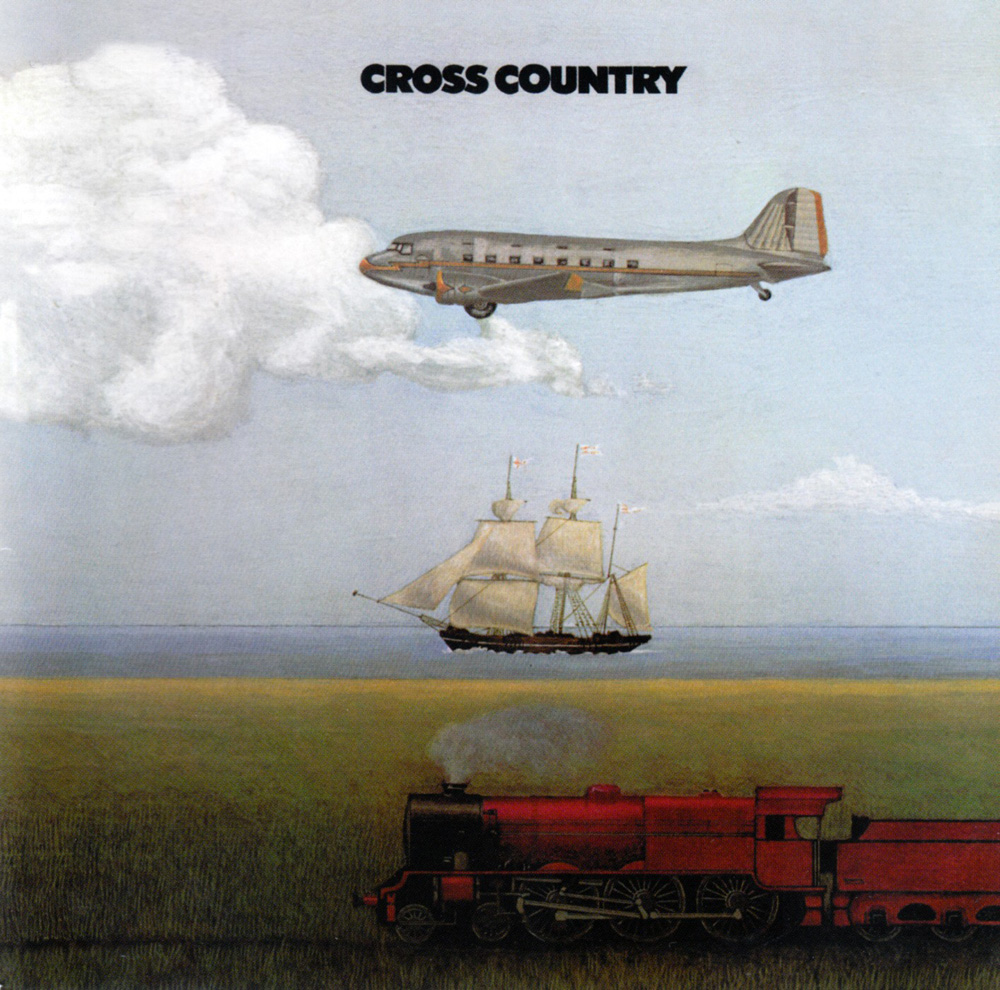
Brooklyn-based Cross Country, it was actually a side-project of The Tokens, formed by brothers Mitch and Phil Margo, together with Jay Siegel, and backed by some great musicians. They released a lone, self-titled album in 1973, and it's quite nice. It's mostly harmonic Americana, similar in the vein of Simon & Garfunkel, Beach Boys and the lighter side of Crosby Stills and Nash.
The record is really lovely a little slice of early 70s rock, with requisite country, folk and pop overtones, with wonderful harmony work to boot. Most of the material was written by Mitch Margo except two songs, the Wilson Pickett's tune “In the Midnight Hour” (written by Steve Cropper and Pickett), and "Choir Boy" penned by Milo Sobel.
Mitch Margo died November 24th, 2017, of natural causes at his home in Studio City, California, at the age of 70. His brother Phil passed away at a hospital in Los Angeles, California, after suffering a stroke, on November 13, 2021, at the age of 79.
Tracks
1. Today - 2:42
2. Just A Thought - 3:18
3. Cross Country - 3:49
4. In The Midnight Hour (Steve Cropper, Wilson Pickett) - 3:14
5. Things With Wings - 2:00
6. Extended Wings - 2:35
7. Tastes So Good To Me - 3:10
8. A Fall Song - 2:49
9. Choir Boy (Milo Sobel) - 3:20
10.A Ball Song - 2:50
11.A Smile Song - 4:28
All compositions by Mitchell Margo except where stated
Panama Limited, having dropped the “Jug Band” from their name, and having seemingly psychedelicised themselves while listening to Captain Beefheart, no doubt taking a tip from label mates The Edgar Broughton Band in the process, are an entirely different proposition on their sophomore and last album Indian Summer. Firstly all but three of the songs are written by Denis Parker, who was definitely under the good Captain’s spell, even down to adopting a sub-Beefheartian growl. Of the three remaining songs, Future and Darkness Brings are penned by Dave Griffiths, and Laughing by Anne Matthews, and all three are at the end of the album, almost as if Denis didn’t want his thematic muse disturbed. The story gets weird when it is revealed in the liner notes that Denis left the band during the recording sessions for the album, and headed back home to Canada, which must have been the fatal blow that ended the band, one assumes?
Released a year after their debut the band have become steeped in the hippy culture of the era and picked up electric instruments. The country element is still there, but fizzed through with eeeeee-lec-triciteee. Ironically, just as Panama Limited were trying to progress and leave their jug band beginnings behind, Mungo Jerry had their hit In The Summertime, prompting Harvest to ask if the band would take a step backwards to secure a cash-in hit. It seems even the most revered of underground labels were not averse to applying biz pressures.
Professionally produced at Abbey Road studios, Indian Summer has a much more polished and serious feel compared to that of the happy-go-lucky debut. That’s not to say it is po-faced, as these grooves feature all the acid-fried lunacy familiar to Beefheart and Broughton fans. An exception to this is the Anne Matthews’ led title track Indian Summer, which has a more traditional folksy feel to it and contrasts nicely with the bug-eyed beans from Venus that surround it.
Dave (not the more formal David of the first album) Griffiths’ Future shows that he too had been listening in rapture to Trout Mask Replica, and it is a bass-led time signature limb-twister that Rockette Morton would be proud of. Darkness Brings on the other hand is a 1967 psychedelia throwback and sounds like it should have been a b-side to a Fire single. Denis’s Beefheartian growl at least makes it sound a little different. We end with Anne Matthews’ Laughing, a twelve-bar that harks back to the first album, but with a boozy feel when Anne’s vocals lurch in.
Could it be that the final three tracks were written after Denis jumped ship in order to complete the album? That may explain the disjointed feel to what was the second side of the original LP. No matter, it is a fairly enjoyable if somewhat derivative romp, mostly through the deserts of Surrey.
Definitely not what I was expecting from a 1974 private pressing with a strangely modern sleeve and a pedal steel guitarist. News, who were four or more lads from Yale University, had the late 60s sound nailed down five years too late, but who’s to complain about a throwback to the best era in rock history? Hot Off The Press is a unique and unknown LP featuring super tight performances, lovely four-part harmonies, and songs that won’t take long to get comfortably lodged in your head.
Kicking off with a pysch-flavored spliced radio parody performed by some of the band members, Hot Off The Press gets right into its first sweet spot with “Loser,” showcasing Mark London’s expert and refreshingly twang-free steel. Throughout the record’s nine songs he has no trouble fitting the instrument in with a pop/rock sound, and essentially designs the rare flavor of this record with soaring, jazzy licks. There are a couple pretty tough rockers, and I must agree with Llama where he labels “One Night Stand” a “so-so Creedence ripoff.” But lighter fare like “Ooo La La” and “Misty Day” (one of the band’s first songs) groove with the sunny sound of Montage. I love the jabber at the end of optimistic bopper “Easy Street:” “…somebody’s way off key…I was doing a 7th,” which adds just the right amount of silliness to this laid-back affair. “Farmer’s Daughter” gets bonus points for the album’s second Beach Boys reference and “New York City” ends the original lineup with an 8-minute jam that finally belies News’ sixties psych disguise. Bonus tracks include the 60-second radio bed that got the band their first shot in the recording studio (1970) and an early demo recording of “Misty Day.”
The CD package is a mini-repro as faithful to a vinyl sleeve as I’ve ever seen, the extensive details of the News story told by principal songwriter Bob Pretcher in the liners. But if you’re willing to shell out some bucks, I’d say go for one of the limited 1974 sealed pressings available direct from Yoga Records. Don’t miss this excellent reissue.
by Brendan McGrath
"Hot Off The Press" is a unique and unknown LP featuring super tight performances, lovely four-part harmonies, and songs that won’t take long to get comfortably lodged in your head. ...These guys had a distinct knack for good hooks and lots of unexpected compositional flourishes. …The bulk of it is terrific 1960s westcoast-flavored folkrock with a dreamy psych vibe and good vocal harmonies. …
If songs like “Loser” and “Misty Day” had gotten attention from record execs, you’d be listening to News on classic-rock radio. …My pick hits are the powerful “Loser,” with a stunning steel guitar solo, and the long album-closer “New York City,” but this is consistent enough that any given listener could feel equally strong about any two others. …There is something timeless about this record, something difficult to put your finger on, yet it grows with repeat listens. …
Here’s a unique and outstanding 70s pop album. The lead instrument is a pedal steel guitar, played with more imagination than almost anywhere. …it can turn a run-of-the-mill country-rock song into a shit-kicking anthem…with soaring, jazzy licks. …This reissue, that boasts two additional tracks, shows off News' honey-tinged harmonies and West Coast easiness, making it one of those great gems that roll out of the seemingly endless vaults. …Here’s a unique and outstanding 70s pop album.
Tracks
1. Radio Blahs (Dean Charles Pailler) - 3:02
2. Loser - 3:09
3. Ooo La La - 2:43
4. Farmer's Daughter - 2:33
5. Misty Day (Bob Prechter, Vic Machcinski) - 4:02
Keyboardist and singer-songwriter from New York, New York, who was kicked out of school for his part in a concert espousing civil rights with his childhood friend, Andy Kaufman. He was in a band called The Living Few and they recorded a demonstration reel, but nothing much came of it. Then he joined Jimmy James and the Blue Flames, which was Jimi Hendrix’s first band.
In 1969, Mark met Todd Rundgren and the two of them set up shop in their own recording studio, Secret Sound. This led to Mark becoming the associate producer and musical director of the album, Music from Free Creek, an all-star extravaganza featuring Jeff Beck, Eric Clapton, Dr. John and Linda Ronstadt, which was released on vinyl in 1976 and CD in 2003.
In 1970, Mark appeared on several albums, including Great Speckled Bird, Taking Care of Business by the James Cotton Blues Band, Kooper Session – Al Kooper Introduces Shuggie Otis, a pair of singles by Allan Nicholls, and Runt by Todd. He collaborated with Buzzy Linhart on Buzzy Linhart is Music and Music, Oliver on Prisms, Carly Simon on her self-titled effort, and Johnny Winter on Johnny Winter And in 1971.
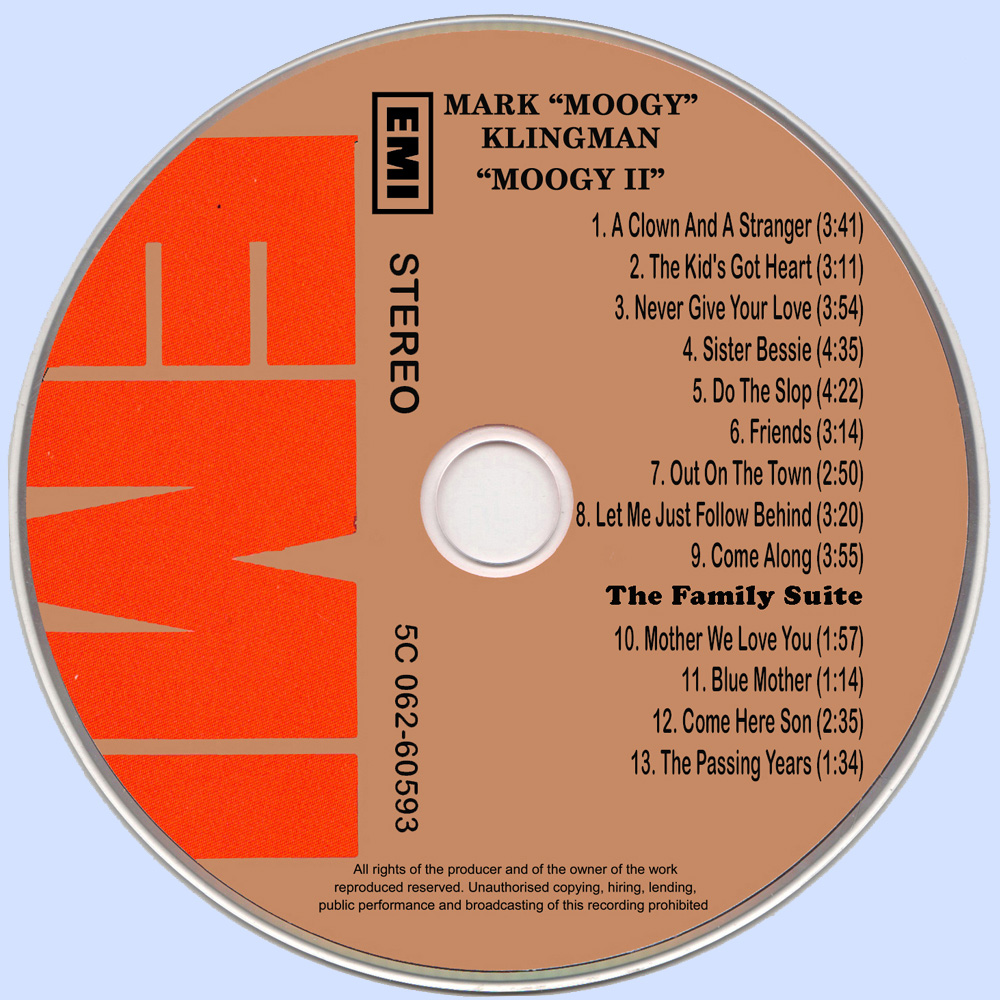
In 1972, he was approached by Lou Reed to contract some musicians for a tour in support of his new album, Transformer. It was a busy year for Mark, who released his own debut, simply titled Mark “Moogy” Klingman, which spawned the single, “Making the Rounds at Midnight”. He also squeezed in time to work with Buzzy on Buzzy (The Black Album) and The Time to Live is Now, Bette Midler on The Divine Miss M, and Todd on Something/Anything?, all the while fronting Moogy & The Rhythm Kings. At that time he recorded his sophomore effort in his loft in New York City with The Rhythm Kings and backing by several great musicians, the album wasn't released until 1978.
In 1973, he appeared on Johnny’s Still Alive and Well and Todd’s A Wizard, A True Star. These were followed by The Handsome Devils by Hello People and self-titled albums by Todd and Utopia in 1974. In 1975, he played on Initiation by Todd and Another Live by Utopia. Then he produced Bette Midler’s 1976 album, Songs for the New Depression, and had a hand in her 1977 LP, Live at Last. In 1978, he released his second solo album, Moogy II, and appeared on Meat Loaf’s Bat out of Hell and Todd’s Back to the Bars, which was recorded at The Bottom Line in New York City.
He reunited with Carly Simon on 1981’s You’re So Vain and wrote the soundtrack of the film, Fear, Anxiety & Depression, which hit the screens in 1989. In between, he occupied himself by writing a play doing a cable television and radio program, and fronting Moogy & the Mojo’s.
Recordings on which he participated in the 1990s include Bette of Roses and Experience the Divine by Bette, the soundtrack of Hail Caesar by Anthony Michael Hall, Free Soul by Todd, City in My Head by Utopia, and White Hot Blues by Johnny Winter. In 1999, he released Old Times, Good Times: A Musical History Part I, a real mixed bag that includes guest artists such as Randy Brecker, Rick Derringer, Fanny, Todd, and Luther Vandross. He followed this up with The First Recordings in 2000, and reunited with Bette on 3 for One and Todd on Reconstructed.
Around this time, Kevin Ellman approached him about co-founding a new band—Mark was still busy with the Mojo’s but most of them followed suit—and Freak Parade was formed. In 2001, they issued Take Your Place in the Freak Parade and Mark pitched in No Time to Live by Johnny and Another Side of Roxy by Todd.
On 1st February 2002, The Moogy Klingman Band played Live at the Triad in New York and the concert has been captured on CD. He also spearheaded a benefit concert for Buzzy which included the talents of David Amram Eric Andersen, John Sebastian, and Phoebe Snow. On 2ndOctober, he returned to the Triad in concert with Freak Parade and Todd Rundgren.
In 2003, he collaborated with Todd on Can’t Stop Running. It is an appropriate title for an artist who has gone on to start yet another band, The Peaceniks, who are mainstays at the P & G Bar in Manhattan, New York, and have recorded a pair of albums, Here Come the Peaceniks and New World Coming.
He passed away from bladder cancer in November 2011 when he was 61 years old.
"Lady of the Lake" comes in with the trifecta of mystic keyboards, jazz-bass, and stunning guitar soloing. In 1976 this 10 minute epic initiated a 30 year love-affair. Starcastle's mixture of symphonic rock and powerful rhythm section invited the listener to spin the album time and again. And I whole heartedly admit that I did. Upon each listen the melody, harmony and groove would find different avenues through my cortex to weave its magic spell.
It seems hard to believe that something that was created by such a young group of musicians has had the lasting power that this debut album retains. Listening today brings back all the awe that it did when I was a teenager. Bassist Gary Strater has the rapid bass grooves that defined much of 70s rock-n-roll. His ability to give a song a unique aura allowed the other talented musicians to fill in the rest of the picture. Steve Hagler and Matthew Stewart were the tandem guitarists that soloed when necessary but usually played the counter-melody fills. The keyboards and awesome vocals of the entire band provide catchy melody that float along the surface of your mind. Terry Luttrell was the lead vocalist, but harmony is just as key as lead here. The vocal tracks may be what get you listening, but it is the guitar/keyboard inter-play that starts to pierce your soul. And just when everything is moving, Strater and drummer Steve Tassler lay down the groove that hooks you for life.
Drummer Stephen Tassler agreed to inject some insight into the making of the classic Starcastle album.
...Starcastle was originally called St. James, and were a college band at the University of Illinois. They played a variety of clubs and other parties around town when their schedules permitted, considering they were all students. Of the people that eventually impacted Starcaste, Steve Hagler, Herb Schildt and my brother Paul were members. Paul plays bass. There were other members that didn't continue to the early SC days. My involvement began the day I graduated from high school in June of 1972. The previous drummer, Mike Castleberry, graduated from college that spring, and the other guys had one more year to complete, graduating in 1973. I came down to Champaign to play because Mike quit to go get "the real job"....
...Matt Stewart was a prodigy, playing around Champaign/Urbana in clubs from a very early (illegal) age. He and Terry Luttrell (of course his history is well known) were playing in a Champaign-based band, doing covers, called Sea Daddy. We had our sights on them both. Matt and Gary knew each other (Champaign music scene was pretty tight-knit) and Matt would come out to see us, have a good time. We started talking, and somehow things came together. Terry wouldn't play without Matt (and deservedly) and they both came to rehearsal and somehow joined the band. This was the lineup that existed for the duration of the band until it's demise in 1980. We played on (on and on and on...) with the intent of getting a record deal. Terry's experience was invaluable to us, and led us to believe we could do it. I'd say we played as this group for most of 1974 and 1975...
...A major concert promoter from St. Louis, Contemporary Productions, consisting of Irv Zuckerman and Steve Schankman, were interested in becoming managers. They heard the first Golden Voice tapes, loved the stuff, and decided to take us on as a project... They had us re-record Lady of the Lake and Forces in a St. Louis studio run by a guy named Steve Littman, who began working with Contemporary Productions as well, and is mentioned in the first record credits. They shopped the tapes, and a couple of labels were interested. Of course we were signed to Epic after Aerosmith's manager came out to see us at a club near St. Louis. I guess they thought we were OK, and gave CBS the green light. The music business was at the time, and for the most part still is, who you know and who you owe! The rest is history (well, almost).
We learned about the signed record deal by a phone call during a party on the night of my 21st birthday, April 2, 1975, at the band house! I will never forget the feeling. As you can imagine, we were ecstatic. (Cake, and eating it too!) We had a lot to learn, however.
Starcastle, although only 40 minutes long, contains one powerhouse after another. "Elliptical Seasons" has a killer bass grove running through it with amazing harmonies. "Forces" is a classic of 70s prog-rock. Luttrell has the vocal quality to carry this song while the rest of the band interject changes, fills, and counter-melody. "Stargate" is a nice instrumental that acts as an intro to my favorite Starcastle tune, "Sunfield". "Sunfield" just soars. Herb Schildt takes his keyboards all around this tune and once again the rhythm section acts as the driving force.
...The songwriting was done as a group. Someone would bring an idea, and we'd all brainstorm on it, play it, change it, refine it. Someone else might suggest a transition or change, and we'd add that if it worked. For me, the songwriting is the greatest part of being in a band. It's the part that is the most personal, and the most self indulgent, but doing it as a group placed checks and balances on that. If someone was critical of a part or suggestion, it pretty much meant that the part would not work or be included. There were no dictators, and there were different leaders on any given day. Lyrically, Steve Hagler was responsible for the Lion's share. We rehearsed the vocals extensively...
The time and effort, the sharing of ideas, and the complete interaction of the band members is what one remembers from Starcastle. "To The Fire Wind" and "Nova" could only be made by a band that was completely in sync. "Nova" has the fastest tempo on the album and closes out leaving the listener dieing for more.
...Personal favorites are just that....People have different memories and favorites, maybe having to do with their part in the song, either playing or writing. My feelings of the songs have to do with how they changed, how they came off live, and how I felt when I played them. Herb may feel completely different due to the problems he might have, such as how much time he had to change a Mini Moog sound or whether they stayed in tune. Terry may feel differently depending on whether he could hear the monitor of if the drums were too loud, etc. I've always enjoyed Lady of the Lake. We played it at Gary's benefit after rehearsing it a few times the day before (after 25 years!). Everyone had to relearn their parts, and did it individually before we got together. I was able to glue them all together, fortunately. I think we've all been playing it in our sleep after all these years.
Elliptical Seasons was a nice follow up to Lady of the Lake, especially with it's quieter opening. I recall playing it with Matt outside the control room with his Strat, sans amplifier, and with my crotales. Vicari came through and wanted to record that sound, because it breathed so well, but we didn't end up doing it. This song fell out of the repertoire after Fountains of Light. Forces changed quite a bit over the years, until it found it's lowest common denominator. The beginning part was pushed aside, and the song became more powerful. We also played this at Gary's benefit, along with Change in Time, after opening with Shine on Brightly from Citadel. We opened our show with Stargate, and the recording of it was used before a good number if 9:00 news shows, I'm told. Playing it live was always very dynamic, although it would have been fun to get all the percussion stuff working live. These days I could use samples and drum pads, but back then I couldn't afford all the gear that Carl Palmer had behind him. My favorite song from the record is Sunfield. I think it is one of the best things we did. Compositionally it's the most interesting to me, I loved to play it. It could really get going live, too. It would go from being very quiet to a tornado of sound. It's my all time favorite SC song, and I'd love to play it again.
To the Firewind was a song with Herb's organ really churning, another powerful song live. I remember trying different tempos during the recording of that song, with an up tempo version winning out in the end. All of the parts that were eliminated from the Chronos 1 version had been done by the band, all for the betterment of the song, we felt. Nova was always a crowd pleaser, with its quicker tempo and dynamics. It led well into Breath and Thunder live, which always got us an encore, unless the headliner pulled the plug. We never put that song on a record, but we should have. Boston made us quit playing it live when we toured with them, or they'd kick us off the tour. Business decision...
When an album is still being talked about years after it was written, there are bound to be as much bad press as good. But let me state one fact, this is an album that thrilled and amazed many a listener in the 70s. Its longevity and influence make it a classic. If you have never heard this band, or haven't spun it since the days of vinyl, I urge you to do yourself a huge favor and take a listen. And then listen again and again. You will be amazed by what goes on in your head while listening to this masterpiece. Starcastle was one of the primary reasons I got into music in the 70s. And it still holds my emotions today. We can relieve an amazing time in our lives with Starcastle, Fountains Of Light, and Citadel. And in the near future, we may get another treat:
...The new record is sounding very good, and is in the mastering stages. I can't be more specific at this time, but it won't be much longer. Too bad Gary will not see it happen. Fortunately, he heard everything recorded that will be on the record before he died...
by Steve Ambrosius
Tracks
1. Lady Of The Lake - 10:28
2. Elliptical Seasons - 4:29
3. Forces - 6:26
4. Stargate - 2:54
5. Sunfield - 7:36
6. To The Fire Wind - 5:15
7. Nova - 2:35
All compositions by Matthew Stewart, Steve Hagler, Gary Strater, Herb Schildt, Steve Tassler, Terry Luttrell