Tuesday, November 21, 2023

Gabriel Bondage - Angel Dust / Another Trip To Earth (1975/77 us, good space psych prog rock, 2009 digipak release)


Gabriel Bondage was an American post-psych band from Chicago that released the album Angel Dust on local-press Dharma in 1975, followed by Another Trip to Earth in 1977.

Their name was inspired by Gabriel Prosser, an enslaved 18th century blacksmith who — held in bondage on a Richmond, Virginia, plantation — became a martyred early hero of the abolitionist movement after planning one of the earliest anti-slavery revolts.

The group formed in 1973 as One Brain when singer and multi-instrumentalist Rex Bundy, a former writer of religious music, enlisted bassist Tony Stram, once of the Pink Floyd covers band Stark Raving & Mad. They grew to a six-piece with reedist Bill Wisniewski, who once rubbed shoulders with members of Chicago.

As Gabriel Bondage, they opened an early US date by Canadian rockers Rush. Bundy developed a set of originals, influenced by The Beatles, Genesis, and Emerson Lake & Palmer.

Gabriel Bondage signed to Dharma Records, a Libertyville, Ill., indie label whose roster included jazz-rockers Streetdancer and the symphonic trio Atlantis Philharmonic.
Jazz-Rock-Soul
Tracks
1. Babylon - 4:44
2. First Stone In A Pyramid - 3:45
3. You And The Wind - 3:47
4. Take My Eyes - 3:09
5. Ladies And Gentlemen - 4:26
6. Bondage Rust Flakes, Dinosaur, Implosion - 8:10
7. Island - 3:59
8. Sing Me A Song - 3:30
9. Take It On A Dare (Ron Schwartz) - 6:02
10.Long Time - 3:47
11.Living In The City - 4:04
12.Birth Of The Unconquered Sun (L.James Biernacki) - 5:32
13.In The Daylight - 4:00
14.No Winners - 5:01
15.All I Know (L.James Biernacki, Rex Bundy) - 3:51
16.Those Games - 3:51
17.Fallen Angels - 11:11
All songs by Rex Bundy except where stated

Gabriel Bondage
*Rex Bundy - Lead Vocals, Guitar, 12-String Guitar, Drums, Piano, Effects) 
*Tony Stram - Vocals, Bass, Keyboards, Programming 
*Larry Biernacki - Vocals, Guitar, Mandolin 
*Bill Wisniewski - Lead Vocals, Backing Vocals, Alto Saxophone, Tenor Saxophone, Baritone             Saxophone, Flute, Clarinet 
*Ron Schwartz - Piano, Synthesizer, Hammond Organ, Programming 
*P.J. Shadowhawk - Drums

Monday, November 20, 2023

The Woods Band - The Woods Band (1971 ireland, lovely folk with traditional expressions, 2021 digipak remaster)


The Esoteric eye for an item of musical buried treasure turns its attention on this occasion to the world of early-’70s folk-rock. However, before you go away thinking that this was another bunch of fly-by-night nobodies, coming in from nowhere and going back there as quickly as possible, think again. Because The Woods Band were historically extremely significant in the fast-blossoming world of British and Irish electric folk music when this album was released in 1971. The first, and most significant, reason for this is because the ‘Woods’ part of the band name refers to Irish husband and wife team Terry and Gay Woods who, as anyone with an interest in that scene will surely recognise, were founder members of Steeleye Span in 1969. 

Indeed, it was Terry Woods who first joined up with Asley Hutchings after the latter’s departure from Fairport Convention and decided to put together a new band. Tim Hart and Maddy Prior were brought in, and the five-piece recorded the first Steeleye album Hark! The Village Wait, in 1970, with Gay and Maddy sharing the vocal duties. The Woods left the band after this first album, but their legacy and their place in folk-rock history was secured. Terry Woods had also been with another band who helped to spearhead the nascent movement, namely Sweeney’s Men, who recorded an album in 1968.

The Woods Band was formed by Terry and Gay after their departure from Steeleye, bringing in guitarist Ed Deane (who later replaced Gary Moore in Irish band Skid Row, in rather a musical about-face) and also excellent drummer Pat Nash. Gay’s brother Austin Corcoran was also in the band for a while on bass, but departed while the album was being recorded (either owing to musical self-doubt or a disapproving wife, according to the accompanying booklet!), though he is on three tracks. Producing the album was Tony Reeves, during a break between his spells with Colosseum and Greenslade, which is a rather nice ‘prog’ connection. The folky significance is not done yet, however, as the story goes that fellow Irish folk-rock pioneers Horslips might never have existed without The Woods Band, as they turned up at a Woods show, were reportedly entranced, and elected at that point to form their own band ploughing a very similar furrow to the show they had seen which, if true, is another factor making this recording something of a defining moment in the electric folk scene.

Given all of that, the first surprising thing when putting the CD in to play, having seen the ‘Trad Arr.’ credits scattered throughout the eight tracks, is that the album is far from entirely based in the English or Celtic folk sound. Much of it is, of course, but three songs at least (opener Everytime, Promises and the extremely Sandy Denny-esque Dreams) are equally rooted in American folk, with an air of some of the material that Jefferson Airplane or even The Byrds were doing in the ’60s. This is reaffirmed by Woods in the booklet notes, as he confirms that one of the influences he had was The Band, and the work they were doing in adapting traditional Americana to a modern rock framework. This balance makes the album work very well, as it avoids any risk of sounding too samey at any point and all comes across fresh. The Horslips connection is blindingly obvious in the Woods-composed Noisey Johnny (note spelling), while the ‘jigs and reels’ selection which seemed mandatory on folk-rock albums of the time manifests itself in Lament & Jig, which as the title suggests, juxtaposes a stately piece (Valencia’s Lament) with a celebratory one (Apples In Winter). It’s very good.

Probably the best moment to these ears, however, is the traditional arrangement of the song As I Roved Out, which takes the Fairport template used on songs such as Matty Groves and creates a perfectly crafted piece of traditional electrified folk-rock. Pat Nash’s drums are exceptional on this piece, contributing lovely little rolls and fills throughout, and a slightly experimental mid-section sees the whole band jamming to great effect in a far more ‘rock’ way than elsewhere on the album. The starkly accompanied January’s Snows shows perfectly why Gay Woods was the original choice for Steeleye vocalist, and indeed why she later rejoined them in the ’90s for a further six years, as her vocal is trad folk perfection on this fragile, aching piece.

Sadly, when the album came out, the label (Greenwich Gramophone Company) almost immediately folded – a fate also befalling fellow bands Open Road and Samurai – and The Woods Band split following the album’s failure. The Woods couple continued for a while as Gay And Terry Woods, and also hooked up for a short while with Doctor Strangely Strange, but apart from a second Woods Band incarnation briefly formed by Terry in 2002, the world had seen the last of The Woods Band, which is a great shame.

Anyone with an interest in that period of folk-rock, or who is a fan of early Fairport, Steeleye or Horslips, really ought to check this out. Quite apart from its historical significance, it remains an excellent listen, and it really should be in any self-respecting folk-related collection.
by Steve Pilkington,  July 4, 2021
Tracks
1. Everytime (Terry Woods) - 5:46
2. Noisey Johnny (Terry Woods) - 2:37
3. January's Snows (Edmund John Deane) - 4:24
4. Lament And Jig (Including 'Valencia Lament' And 'Apples In Winter') (Edmund John Deane) - 5:39
5. Dreams (Terry Woods) - 4:15
6. As I Roved Out (Edmund John Deane) - 5:01
7. Promises (Gay Woods, Terry Woods) - 5:18
8. Over The Bar (Including 'The Road To Athy') (Gay Woods, Terry Woods, Edmund John Deane) - 3:36

Personnel
*Terry Woods - Acoustic, Electric, Bass Guitars, Mandola, Concertina, Vocals
*Gay Woods - Concertina, Autoharp, Dulcimer, Bodhran, Vocals
*Ed Deane - Electric, Acoustic, Slide, Bass Guitars, Harpsicord
*Pat Nash - Drums, Vocals


Sunday, November 19, 2023

Virginia Tree - Fresh Out (1975 uk, wondrous melodic acoustic electric folk psych, 2000 edition)


Virginia Tree is the pseudonym of the former Ghost vocalist Shirley Kent. After the demise of Ghost (the British progressive '60s band, not the Japanese band of the same name) in the early '70s, Kent joined former Ghost band members Paul Eastment and Terry Guy to record Fresh Out. This album contains nine original folk- and jazz-styled compositions as well as a cover of Jimmy Dorsey's "I'm Glad There Is You." Only 1,000 copies of the album were originally pressed on the Minstrel label in 1975, and it soon became a collector's item. 

This is the first time this album has appeared in CD format and it has been re-released in a slightly oversize cardboard gatefold sleeve which reproduces the original album's graphics. It also contains detailed liner notes outlining the history of Ghost, including Shirley Kent's involvement with the band and her subsequent solo career. This CD reissue also contains two extra tracks that have been recently recorded by Kent. 
by Keith Pettipas
Tracks
1. Hiding There (Virginia Tree) - 3:23
2. In My Garden (Virginia Tree) - 3:17
3. Like Morning (Virginia Tree) - 4:57
4. Wicker Basket Weaver (Virginia Tree) - 2:27
5. I’m Glad There Is You (Jimmy Dorsey) - 4:44
6. Make Believe Girl (Mo Lawless, Virginia Tree) - 4:43
7. Harlequin And Columbine (Virginia Tree) - 5:06
8. Comical Wise (Virginia Tree) - 2:30
9. Let Us Go Dancing (Virginia Tree) - 3:19
10.Fresh Out (Virginia Tree) - 4:01
11.I've Got To Get To Know You (Shirley Kent Tipping) - 2:54
12.Forever A Willow  (Shirley Kent Tipping) - 3:55

Musicians
*Virginia Tree - Vocals
*Malcolm Gibbons - Guitar
*Paul Eastment - Lead Guitar
*Hal Shaw - Piano 
*Terry Guy - Piano
*Paul Eastment - Harmonica 
*Virginia Tree Acoustic - Guitar 
*Derek Hughes - Bass 
*Jeff Pearson - Bass
*Phil Sperring - Drums 

Related Act

Saturday, November 18, 2023

Everpresent Fullness - Fine And Dandy The Complete Recordings (1966-70 us, nice sunny folk surf roots 'n' roll, 2004 remaster)


The story of the Everpresent Fullness is one of record company politics, missed opportunities, and -- above all -- good music. Rev-Ola's Fine and Dandy: The Complete Recordings presents the music as the band intended for the first time, and in the process unearths a darn good group that played a high-energy blend of folk, jug band, and pop music with the occasional harder-edged garage-style track -- sort of like a happy kid brother to the Lovin' Spoonful or maybe a jacked-up Byrds, though not as strong in the vocal department as either of those bands. 

Their only album, The Everpresent Fullness, was released in 1970, four years after it was recorded and long after people stopped caring about music like theirs. This collection is made up of tracks from the original album, both sides of their second single, an unreleased demo acetate, and five demos that predate the group's formation. The first seven tracks are taken from the album and were remixed by bandmembers Nick Walusko and Paul Johnson in 2003. The group always felt that producer Bones Howe had botched the final mix, making it too poppy. Amazingly, Howe still had the original tapes and handed them back to the band to revamp. Now the songs fairly jump out of the speakers, sounding very alive and exciting. The best tracks, like the very Nesmith-sounding "My Girl Back Home" and their strong take on "I Know You Rider" (here called "Rider"), sound like they could have been hits in 1966. 

The tracks the group recorded for their second single contain their best original songs; "Darlin' You Can Count On Me" is a snarling Dylan-inspired rocker and "Yeah!" is a rollicking instrumental the band never had a chance to put vocals on. Best of all might be the unreleased take of Dylan's "It's All Over Now, Baby Blue." It's one of the most commercial versions of the song, giving the track a bouncy Spoonful sound and adding some wonderfully cheesy female vocals on the tag line. The five tracks featuring three-fifths of the Everpresent Fullness (guitarist Paul Johnson and vocalists Jack Ryan and Tom Carvey) are pretty straight folk-rock numbers with nice harmony vocals. 

The songs they cover include a folk standard by Tom Paxton ("Sometimes I Don't Know Where I'm Bound"), a couple of Dale Hawkins songs ("Suzie Q," "La Do Da Da"), a Buddy Holly track ("Lonesome Tears"), and a strong original by Johnson ("The Rovin' Kind"). It is nice to hear the roots of the band, but the tracks aren't much more than a pleasant diversion. The real strength of the disc lies in the tracks by the full band. That their record company sank the group's fortunes is not a huge surprise, and while it was a real shame for them, luckily the story turned out okay and fans of '60s folk-rock have this excellent document. 
by Tim Sendra
Tracks
1. Fine And Dandy (Kay Swift, Paul James) - 2:12
2. Wild About My Lovin'  (John Sebastian) - 2:39
3. Leavin' California (Richard Farina) - 2:29
4. You're So Fine (Lance Finnie, Willie Schofield) - 2:37
5. Rider (Traditional) - 2:01
6. The Way She Is (Warren Zevon) - 2:30
7. My Girl Back Home (Paul Johnson) - 2:25
8. Darlin' You Can Count On Me (Paul Johnson, Terry Hand) - 1:58
9. Yeah! (The Everpresent Fullness) - 2:42
10.Sometimes I Don't Know Where I'm Bound (Tom Paxton) - 2:35
11.Lonesome Tears (Buddy Holly) - 1:51
12.The Rovin' Kind (Paul Johnson) - 2:09
13.La Do Da Da (Dale Hawkins, Stanley Lewis) - 2:40
14.Suzie Q (Dale Hawkins, Stanley Lewis) - 2:24
15.It's All Over Now Baby Blue (Bob Dylan) - 2:12
16.Doin' A Number (Richard Farina) - 2:30
Tracks 10-14 as Carvey And Ryan

Everpresent Fullness
*Jack Ryan - Autoharp, Harmonica, Trumpet, Washboard, Vocals
*Steve Pugh - Bass
*Terry Hand - Drums
*Tom Carvey - Guitar, Lead Vocals
*Paul Johnson - Lead Guitar

Thursday, November 16, 2023

Pidgeon - Pidgeon (1969 us, wonderful baroque folk psych)


Pidgeon's obscure, sole self-titled album is most notable for marking the recording debut of Jobriath (here billed as Jobriath Salisbury), who five years later became notorious as a failed glam rocker whose debut solo album didn't come close to justifying its hype and promotional budget. In Pidgeon, however, he was just an ordinary if somewhat effete pop-psychedelic singer/songwriter, also playing keyboards and guitar on the record.

In mid-1968, Jobriath Salisbury left the Los Angeles cast of the Hair musical to hook up with Pidgeon, whose material was co-written with lyricist Richard T. Marshall. Producer and session singer Stan Farber got them a contract with Decca Records, and arranged for them to rehearse for six months in a house before they entered the studio to record Pidgeon in late 1968. 

Many of the tracks employ tinny harpsichord and male-female harmonies (with autoharpist Cheri Gage) that are blatantly imitative of the Mamas & the Papas; occasionally, there are more distant echoes of Jefferson Airplane, with Jobriath sometimes faintly approaching the stridency of Marty Balin's vocal style. Containing elements of California sunshine pop, the harmonies of the Mamas & the Papas, the baroque pop of the Left Banke, and a little heavier psychedelia à la Jefferson Airplane, the Pidgeon album was too confused to cohere into a satisfying whole, though Jobriath's high and strident vocals were a big part of the mix. Pidgeon released a subsequent non-LP single in 1969, "Rubber Bricks"/"Prison Walls," before breaking up. 
by Richie Unterberger
Tracks
1. Of The Time When I Was Young - 2:30
2. Milk And Honey - 3:23
3. When She Arrives - 3:07
4. Dark Bird - 3:22
5. Irene - 3:21
6. The Wind Blows Cold - 3:20
7. Penny's Magic Bell - 3:02
8. The Main Line - 3:02
9. Springtime Girl - 3:05
10.The Dancer - 2:38
11.House On A Hill Among Trees - 3:10
Music by Jobriath Salisbury, Richard T. Marshall, Lyrics by Richard T. Marshall

Pidgeon
Bill Strong Smith - Drums, Percussion, Vocal
Cheri Gage - Autoharp, Lead Vocal
Jobriath Salisbury - Keyboards, Guitar, Lead Vocal
Richard T. Marshall - Poetry

Wednesday, November 15, 2023

Wigwam - Dark Album (1977 finland, excellent blend of prog straight rock, 2008 bonus tracks remaster)


Wigwam were the number one progressive rock band out of Finland in the 70's golden era of prog rock. Wigwam's Dark Album (1977) has a tumultuous production history. The original edition did not go past test pressing stage as the band's UK label Virgin rejected it. The band returned to the studio to create the final Dark Album which eventually was released only in Finland on Love Records, as Virgin were no longer interested.
Tracks
1. Oh Marlene! (Jim Pembroke) - 4:52
2. Cheap Evening Return (Pekka Rechardt, Jim Pembroke) - 5:29
3. The Item Is The Totem (Pekka Rechardt, Mats Huldén) - 4:49
4. The Silver Jubilee (Jim Pembroke, Gerard Manley Hopkins) - 3:07
5. Horace's Aborted Rip-Off Scheme (Pekka Rechardt, Jim Pembroke) - 4:07
6. The Big Farewell (Pekka Rechardt, Jim Pembroke) - 6:28
7. The Vegetable Rumble (Pekka Rechardt, Jim Pembroke) - 5:02
8. Helsinki Nights (Jim Pembroke) - 4:02
9. Grass For Blades (Jim Pembroke) - 9:13
10.Daemon Duncetan's Request (Jim Pembroke) - 5:01

Wigwam
*Jim Pembroke - Vocals, Piano
*Pekka Rechardt - Guitar
*MÃ¥ns Groundstroem - Bass
*Ronnie Österberg - Drums
With:
*Jukka Gustavson - Organ 
*Pedro Hietanen - Keyboards, Accordion 
*Timo Kojo - Backing Vocals 
*Paavo Maijanen - Backing Vocals 


Tuesday, November 14, 2023

Wigwam - Being (1974 finland, stunning art prog rock, 2010 remaster)


This is a weird one. How about an album that sounds like nothing else before or since (a few very vague influences notwithstanding) yet never, throughout its 38 minute duration, veers into avant garde territory? I've never really known what to make of 'Being'. On first hearing it sounds as though it was made up on the spot: the tunes seem random, tentative and unresolved. But unlike, say, 'Trout Mask Replica', there's nothing shambolic or chaotic happening here. Musos will freak at the virtuosity going down, especially the bass playing of Pekka Pohjola which is straight from Planet Genius in the galaxy of Awesome XXI. But repeated hearings reveal far more than technical excellence. 'Being' is a timeless work of the utmost originality which, in spite of a loony communist manifesto lyrical concept, just knocks me out every time I play it.

First, a bit of background for those of you unfamilar with this Finnish wondergroup. Wigwam's history essentially falls into two phases: the first from 1969 until 1974 when the band was dominated by the muse of one Jukka Gustavson, a Stevie Wonder/Steve Winwood-obsessed keyboard-playing vocalist who steered Wigwam from cabaret jazz through Europrog to the unique soundworld of the album under discussion here; and the second from 1975 up to the band's split at the end of the decade when Hull-born Jim Pembroke led a much more conventional, guitar-orientated (but still good) band. The latter phase coincided with a record contract with Virgin and a tour supporting Gong, the nearest Wigwam came to a commercial breakthrough. But it was the earlier phase that was the most interesting, and it remains a crime against human existence that classic albums like 'Tombstone Valentine', 'Fairyport', and, most tragically of all, 'Being', never obtained a UK release. Even now you'll be lucky to get your mitts on this one outside of right-on shops like Freak Emporium or Ultima Thule. I will endeavour to explain why a trip to the said establishments will more than justify the effort and cost.

'Being' consists of ten tracks grouped into segued pairs (mostly with freaky psuedo-lefty titles beginning with the letter P). The first thing that grabs you is the nature of the tunes. With a few exceptions they sound as if they're being played backwards, a bit like Robert Wyatt's contemporaneous 'Little Red Riding Hood Hits The Road'. But they're NOT. Gawd knows where Gustavson and Pohjola got these chord sequences from, but they're like nothing else on Earth. Try to define the tune in the opening 'Proletarian'. It's there, somewhere; the whole thing's thoroughly tonal, the vocal harmonies are intricate (if vague) and Pohjola's Mick Karn-predicting bass "whoops" are a joy to behold, but jeez, as I said before, this is a weird one. Even the lyrics (perhaps thankfully) are difficult to comprehend, and it takes several hearings to be satisfied that you're actually listening to songs being sung in English. 'Inspired Machine' follows with another backward tune over a stilted, oompah beat and the most spaced out fairground theme since 'Mr Kite'. Pembroke gets a rare spotlight with 'Petty Bourgeois' which is far more 'normal' in sound, a fast mover with a delicious middle section, catchy finger-clicking sequence and a coda that could have graced a Mothers' opus, but its companion, 'Pride Of The Biosphere', returns us to never-never land. It's the album's definite low point: a tasteless monologue recited in a mock Tommy Beecham voice over what sounds like Procol Harum jamming on Jupiter. But it's presence is jusified by its contrast with the epic pairing that follows.

'Pedagogue' and 'Crisader' form the album's centrepiece and are the tracks to play first when sampling the record. This is where Gustavson achieves true greatness. 'Pedagogue' is nine minutes of...what can I tell you? Egg, Hatfields, Wyatt all come to mind, but only fleetingly. Key and time changes seem to occur every few bars, the double-tracked vocal line is all over the place, yet it's accessible. Weird, weird, well weird, but accessible. Give it time and you'll be singing this at the bus stop while everyone around you thinks you're deranged. There's a Rhodes solo from heaven four minutes in, and the best non-classical use of woodwind on record permating the bulk of the song. A couple of times it appears to speed up, but never for long. It's tantalising and terrific. 'Crisader' evolves straight out of 'Pedagogue' and rocks big time, like Traffic on steroids, but Winwood and Capaldi never sounded like this. Gustavson sounds like Donald Fagen on speed. The piano and organ interplay is orgasmic and the song is a real foot-tapper, yet the tune, again, is straight from the Bizarro alternate world. Man, I love this record.

'Planetist' is another track with slight Zappa ('Waka/Jawaka' period) overtones, but again, the tune is without antecedent. It features a delightful string arrangement, an inspired dual soprano sax sequence at the end, and bass playing that makes Jaco Pastorius sound like Sid Vicious. It's companion piece, 'Meastro Mercy', has more double-tracked Gustavson vocals and the only guitar on the whole album, a delicately-plucked acoustic enhancing an enchanting waltz-time cosmic melody. The album closes with Pembroke's other showcase, 'Marvelry Skimmer' ('Friend From the Fields'), the most regular-sounding track on the record (and an indicator of the direction Wigwam would follow on 'Nuclear Nightclub' the following year). It is prefaced by Gustavson's 'Prophet', which sounds like an Indian mantra devoid of all ethnic influences - world music from another world - and featuring yet more skybourne bass manouevres and, a couple of times, an ass-kicking fatback beat with ace VCS3 dexterics.

'Being' was released in 1974, when rock music was in its supposed decline. A pox on that. Had Wigwam been given the exposure (and record contracts) of such as Genesis, Yes and Gentle Giant then the school haversacks of the day would have exhibited a damn sight more taste and adventure than they did (at my school at least!). Rock was not so much in decline in the mid seventies: it was simply that the bulk of the bands that dominated the scene were more concerned with musical dexterity than invention. Hear 'Being' and you'll hear plenty of the former, but in the context of some of the most innovative rock music ever created. Make up for a quarter century of neglect and hear this great unsung band's unique music. I doubt you'll regret it.
by Fitter Stoke, 06/08/2002

Ronnie Österberg died in 1980 so it seemed as if that would be the end of Wigwam however in the 1990's, Pembroke, Rechardt and Groundstroem surprised many by coming back with a third version of the band. Jim Pembroke passed away in Oct 2021.
Tracks
1. Proletarian (Jukka Gustavson) - 2:10
2. Inspired Machine (Jukka Gustavson) - 1:25
3. Petty-Bourgeois (Jim Pembroke) - 2:58
4. Pride of the Biosphere (Jukka Gustavson, Pekka Pohjola) - 3:15
5. Pedagogue (Jukka Gustavson) - 9:11
6. Crisader (Jukka Gustavson) - 4:47
7. Planetist (Jukka Gustavson, Pekka Pohjola) - 3:08
8. Maestro Mercy (Jim Pembroke) - 2:32
9. Prophet (Jukka Gustavson) - 6:11
10. Marvelry Skimmer (Jim Pembroke) - 2:32

Wigwam
*Jim Pembroke - Vocals, Voice, Piano 
*Jukka Gustavson - Vocals, Piano, Organ, Mini-Moog, VCS-3 Synths
*Pekka Pohjola - Bass, Violin, Piano, Mini-Moog 
*Ronnie Österberg - Drums, Percussion, Backing Vocals 
With
*Taisto Wesslin - Acoustic Guitar
*Unto Haapa-Aho - Bass Clarinet
*Paavo Honkanen - Clarinet
*Pentti Lasanen - Clarinet, Flute
*Juhani Aaltonen - Solo Flute
*Erik Danholm - Flute
*Kai Veisterä - Flute
*Pentti Lahti - Flute
*Seppo Paakkunainen - Flute
*Pekka Pöyry - Soprano Sax, Flute
*Ilmari Varila - Oboe
*Aale Lingren - Oboe
*Juhani Tapaninen - Bassoon
*Jukka Ruohomäki - VCS-3 Assistance
*Erkki Kurenniemi - VCS-3 Assistance


Monday, November 13, 2023

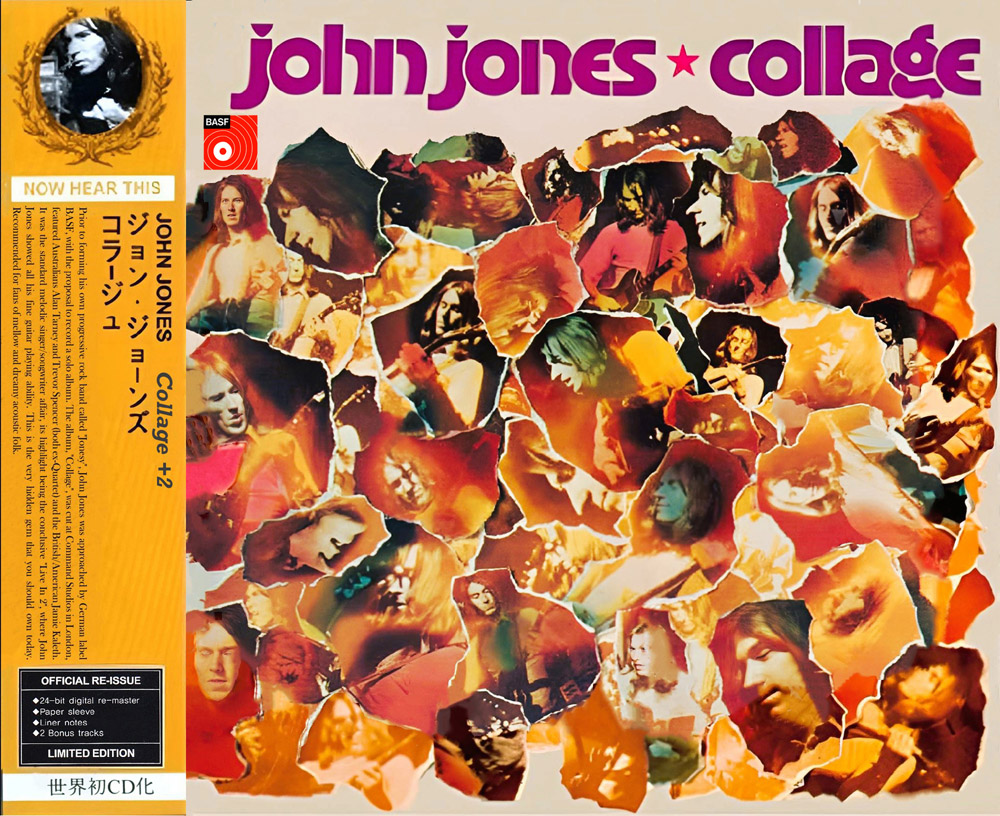
John Jones - Collage (1974 uk, pleasant folk prog rock, 2007 korean remaster)


In 1964 John Evan-Jones (Guitar, Keyboards, vocals) and his elder brother Trevor "Gypsy" Jones (Bass, Vocals) moved from Canterbury to Tasmania with their parents. In Launceston they soon joined a local band, The Revelles, which quickly met with the audience favour. After changing name in Chaos & CO and, with a line-up completed by Graeme Pearce (Drums), John Pearce (Guitar) and Dave Randell (Bass), in 1966 the band got a hit single with "Seven Golden Daffodils/It Was You" (EMI/Columbia) and split after a possible second hit. John and Trevor then formed Mickey Finn, but in 1969 John decided to go back to London, to promote at EMI several songs written in the last couple of years. 

Unlikely enough, not only were his songs left unpublished but also he was denied the possibility to sign to a different label due to EMI requiring an override royalty for him to leave his contract. So Trevor and the rest of the band, who had arrived in London full of hope, went back down under to give life to Sweatty Betty, with Peter Hutchinson (Guitar), Tim Joyce (Guitar) and Dave Witt (Drums), plus singers Jeff Reader and Janet Sexton, the only result of this new band was one 7" single, "Every Little Thing", recorded for Van Diemen in 1971. In the meantime John was making himself known as a session guitarist, playing for artists like Tom Jones, Arthur Brown, Rory Gallagher, Petula Clarke, Charles Aznavour, Dusty Springfield, Arthur Conley, Jeff Beck, Ronnie Charles, New Seekers, London Symphony Orchestra etc.

Thanks to all the contacts and the esteem acquired with all this hard work, in 1971 Polydor approached John asking him to play for American songwriter Jake Holmes (of "Dazed and Confused" fame) during his European tour. One of the support bands on this tour was Irish band Anno Domini, whose guitarist "Tiger" Taylor was having problems with the band's management. John Evan Jones replaced him on stage first and then definitively, and later Trevor joined to complete the new line-up. Anno Domini had already recorded an album and it happened that the two Jones took Taylor's place on the English issue's cover (pressed later than the German one, which shows instead the right line-up). A second album was quickly recorded but remains still unpublished to this day and at this point Anno Domini split-up. John was approached by German label BASF, with the proposal to record a solo album. 

The album, "Collage", was cut at Command Studios in London, featured Australians Alan Tarney and Trevor Spencer (both ex-Quartet) and the British/American James Kaleth. It was the standard melodic singer/songwriter affair, its highlight being the conclusive "Live In 2", where John Jones showed all his fine guitar playing ability. A second solo album "Just A Few Changes" was recorded (but not released) and no one knows its whereabouts today. The meeting with Kaleth, who had moved from Chicago to Lancashire in 1959 and had previously played for one year with White Summer and for a very short time with Crowjane (formed by three ex-Gracious members), gave birth to a new band, called Jonesy.
by Gianpaolo Banelli
Tracks
1. Oh, What A Pity - 3:06
2. That's Alright By Me - 3:28
3. Hey Girl - 3:12
4. Man Of 21 - 3:20
5. Working - 3:43
6. Anthem - 4:53
7. Fade Away - 2:12
8. Smiling Eyes - 3:14
9. Feeling For Today - 3:20
10.Live In 2 - 4:01
11.The Prisoner - 3:44
12.It's Been Such A Long Time - 4:19
All compositions by John Evan Jones
Bonus Tracks 11-12

Musicians
*John Evan Jones - Guitar, Keyboards, Vocals
*Jamie Kaleth - Mellotron, Piano, Vocals
*Alan Tarney - Bass
*Trevor Spencer - Drums
*Alan Bown - Trumpet

Related Act

Sunday, November 12, 2023

Robb Kunkel - Abyss (1972 us, beautiful baroque psych folk rock, 2018 remaster)


“…one of the best, perhaps the best, on the label…displays the typical Tumbleweed combination of a loose, stoned ‘Astral Flash’ vibe and a classy production.” – Patrick Lundborg, Acid Archives

Denver in 1971 was the right place, right time for musician Robb Kunkel. He’d just come off a year rambling around North America before settling in Colorado, landing a gig as a promotions rep for ABC-Dunhill. The weed was potent, magic was in the air, and Kunkel’s life was about to change forever.

The San Fernando earthquake had spurred industry pals Bill Szymczyk and Larry Ray to join forces to form their own label—and get the hell out of California. The duo reached out to Kunkel who helped set up shop for their burgeoning Denver enterprise, Tumbleweed Records. Kunkel secured a headquarters, helped staff the label, and brought in talent, including Danny Holien, Pete McCabe, Dewey Terry. But Kunkel was itching to make a record of his own. Perhaps to repay him, Tumbleweed agreed.

A longtime piano man and blues aficionado, Kunkel had the soul of a poet and the restless spirit of the jazz musicians he also worshipped. For his album, Kunkel wanted a jazz producer, and Szymczyk hired Ed Michel, then the head of Impulse Records, who brought on a string quartet and jazz legend Ray Brown and Wrecking Crew musician Jimmy Bond.

Ostensibly a pop album at heart, Abyss brings all of Kunkel’s influences together and vacillates wildly in style. From folky ditties to pensive wailers, Kunkel’s songs are often piano-driven but rarely straightforward. Tracks regularly veer off into jazz or baroque string arrangements, but there’s a raw quality—in the production and in Kunkel’s literary and at times earnest lyrics. It’s the album of a young and uninhibited musician who has realized a lifelong dream and who takes it seriously, but not too seriously
Light ITA
Tracks
1. You Were The Morning (T. Stockwell) - 4:17
2. Whispermuse - 5:11
3. Country Blues - 1:44
4. O Light - 4:14
5. Abyss - 5:04
6. Monterrey - 4:19
7. Ten Summers - 3:38
8. Airhammer Eddie - 2:29
9. Playa De Bagdad - 2:43
10.Turn Of The Century - 4:35
Music and Lyrics by Robb Kunkel except where noted

Musicians
*Robb Kunkel - Vocals, Electric, Acoustic Guitars, Piano, Tamboura 
*Danny Holien - Electric Guitar, Backup Vocals 
*Gregory Hammel - Drums Percussion 
*Willy Seltzer - Vocals 
*Stephen Swenson - Fender Bass 
*Howard Roberts - Guitar, Banjo 
*Ray Brown - String Bass 
*Victor Feldman - Percussion Congas 
*Diana Lee - Vocals 
*Ed Michel - Airhammer 
*Jimmy Bond - String Bass
*Murry Adler - 1st Violin, Solo Violin, Concertmaster 
*James Getoff - 2nd Violin  
*David Schwartz - Viola 
*Ray Kelly - Cello
*Bud Shank - Flute, Alto Sax 
*Bob Cooper - Oboe 
*Plas Johnson - Bass, Clarinet 
*Bill Perkins - Clarinet

Friday, November 10, 2023

The Gurus - Are Hear! (1966-67 us, exciting garage psych rock with oriental elements, 2003 release)


With the current level of interest in Turkish and middle-eastern psychedelia out there, this may be the perfect time to rediscover the sounds of The Gurus Are Hear. Formed in New York city in the  throes of 1966, the Gurus were the brainchild of a certain Ron Haffkine, a jeweler who liked to hang around at Cafe Feenjon, a hip coffee shop on MacDougal Street that catered to a wild mixture of Arabs, Israelis, and, apparently, psychedelic rock and roll musicians. His concept was a simple one: combine the electric rock and roll beat that was rumbling across the charts with the exotic sounds of the middle east. He put forward the concept to a number of talented local musicians, who not coincidentally also happened to moonlight as Cafe Feenjon regulars, and they went in to cut a record.

The results could easily be compared to what Kaleidoscope was doing across the country at around the same time, but the Gurus really kick things up a notch and cut back on some of the eclecticism that distinguished their musical compadres. The Gurus Are Hear is very much a psychedelic garage rock record, despite the prevalence of Pete Smith’s oud and the eastern warbling (the liner notes reveal that these were often simple obscenities mispronounced in order to sound exotic). The record is full of highlights, including a wonderfully unique take on the old garage band chestnut Louie Louie coated in Smith’s tasteful oud playing. If you thought you’d heard every possible variation on this one you could bear, you may want to reconsider. It really does speak to the band’s credit that, even when delving into cosmic territories, the songs never stray far from their heavy go-go grooves. It may be weird, but it’s always danceable. The single from the record, Blue Snow Night, backed with the crazy album opener Come Girl, even managed to do well enough to land the band on the covers of both Cashbox and Record World magazine.

Despite sounding so ahead of their time, however, the Gurus still come across as being an acquired taste, due in large part to the eccentric singing of (the rather inexplicably named) Medulla Oblongata. His faux-eastern vocalizing may lend the record a good deal of character, but also risk confounding the unsuspecting listener. This is not to say that straighter singing would have made the record any better, however, as his most accessible vocal just so happens to come with my least favorite cut on the album, Rainy Day in London. Despite some intriguing instrumental flourishes, this one is a rather turgid, sentimental ballad about walking in the rain and eating leftover cake that doesn’t quite sound like anything else the band ever recorded.

It may come as a surprise that despite the success of the aforementioned single, The Gurus Are Hear was to remain unreleased until 2003, when the tapes were rescued from the vaults by the good folks at Sundazed Records. Five bonus tracks round out this rather belated release, those being a number of alternate takes of songs already on the record and They All Got Carried Away, a moody psychedelic pop number with some otherwise trying Polly wants a cracker vocal interjections.
by Nik Rayne
Tracks
1. Come Girl - 2:07
2. It Just Won't Be That Way (Jimmy Ryan) - 2:19
3. Contact (Alan Gordon, Garry Bonner) - 2:37
4. Breakaway - 1:37
5. Cry, Cry - 2:44
6. Roads To Nowhere - 2:33
7. Blue Snow Night - 2:20
8. Louie Louie (Richard Berry) - 3:05
9. Everybody's Got To Be Alone Sometime (Jonathan Talbot, Nickalos Schneider) - 2:22
10.Rainy Day In London (David Pickell, Mark Hansen Holden) - 3:05
11.Mystic - 1:51
12.Shaker Life - 2:09
13.They All Got Carried Away (Alan Gordon, Garry Bonner) -  2:04
14.Blue Snow Night - 3:20
15.Cry, Cry - 2:35
16.Mystic - 1:48
17.Contact (Alan Gordon, Garry Bonner) - 2:42
All songs by Jonathan Talbot except where stated

The Gurus
*John Lieto - Vocals 
*Pete ''Blackwood'' Smith - Guitar 
*Jonathan Talbot - Bass
*Victor ''Vittorio'' King - Drums 
*Medulla Oblongata - Guitar 
*Michael ''Jason'' Weinstein - Bass, Harmonica

Text Host