If there’s one song that best illustrates the talent and imagination of Steve Winwood, it’s the 11-minute title track of Traffic’s fifth album, a hypnotic jazz-rock masterpiece and a searing indictment of the music industry.
The song rose up from a lyric Jim Capaldi roused himself to write about the withering effects of the music business on the artist. To this Winwood introduced a musical backdrop that moved like shifting sand: neither solely rock, blues or jazz, but each and more besides, changing almost from one bar to the next.
Altogether, and elsewhere on this, Traffic’s most restless record, shades and styles got jumbled up in the same pot, shaken into new shapes, then broken down and started up again. “It kind of sums up Traffic in a way,” Capaldi said at the time. “The eclectic-ness – you can’t put your finger on it at all, yet you know it’s familiar.”
"Stevie Winwood and I both grew up in the midlands," Glenn Hughes told us, choosing Low Spark... as one of the records that changed his life. "I was mad about his earlier band the Spencer Davis Group, but Traffic really hooked me in. I adored his Hammond organ playing and the subtlety and drama of his voice. Not many people would know that Stevie was a huge influence upon me whilst I was in my mid-teens, and he continued to be so all though my twenties and early thirties."
Classic-Rock, 16 August 2021
Tracks
1. Hidden Treasure (Jim Capaldi, Steve Winwood) - 4:12
2. The Low Spark Of High Heeled Boys (Jim Capaldi, Steve Winwood) - 11:44
3. Light Up Or Leave Me Alone (Jim Capaldi) - 4:51
4. Rock 'n' Roll Stew (Jim Gordon, Rick Grech) - 4:27
5. Many A Mile To Freedom (Jim Capaldi, Steve Winwood) - 7:18
6. Rainmaker (Jim Capaldi, Steve Winwood) - 7:52
7. Rock 'n' Roll Stew (Parts 1,2) (Jim Gordon, Rick Grech) - 6:10
Bonus Track 7, single version
Traffic
*Steve Winwood - Guitar, Keyboards, Lead Vocals, Organ, Piano
*Chris Wood - Flute, Saxophone, Wind
*Jim Capaldi - Drums, Keyboards, Lead Vocals, Percussion
An album that became a Top 10 hit in the UK and a Top 20 hit in America cannot be described with that overused phrase “underrated”, but Traffic‘s self-titled album is a low-key addition to the classic records of 1968, a year when a sense of place distinguished the latest releases from the UK’s premier league bands.
After following the Beatles down the psychedelic rabbit hole in 1967, the Rolling Stones re-established their critical standing with Beggars Banquet, a record firmly rooted in Americana. The Kinks, banned from touring in America since 1965, were now the quintessentially English Village Green Preservation Society. While it cannot be seriously argued that The Beatles (White Album) had a sense of place, 19 of its 30 tracks had been written while they were on retreat in India. During the recording of Electric Ladyland, Jimi Hendrix could just as well have been beaming his guitar by satellite from outer space.
Traffic, meanwhile, came from Birmingham. For much of the 20th century, Birmingham was England’s unofficial second city. Its musical identity would come to be defined by heavy metal upon the surfacing of Black Sabbath. Beneath the radar, it had boasted of a music scene that had flourished in the wake of rock ‘n’ roll, reputedly with more working bands than in Liverpool. Still, by the middle of the 1960s, it had not established the national profile of Liverpool or London.
In 1968, there was a handful of noteworthy album releases by Birmingham-based groups, including the Moody Blues, the Move, and Traffic. All three shared some psychedelic common ground, as per fashion circa 1967, but only in so far as psychedelia equated to pushing boundaries, and the bands would sooner differentiate their musical identities than did the Merseybeat and London blues bands. So, while the Move took their cue from Sgt. Pepper‘s era art-pop and the Moody Blues worked orchestral textures into their proto-prog, Traffic, whose line-up emphasized keyboards and horns, with guitars often pushed back into a supporting role, gradually distinguished themselves as a premier jazz-rock band.
Traffic occupied a plum position on rock’s family tree. Steve Winwood had sung and played keyboards as a teen prodigy with the Spencer Davis Group (and he was only 19 years old when Traffic’s debut record was released in 1967). From that group, he brought along Jimmy Miller, a producer who had “got that art of being able to put music into words” and would start work that same year with the Rolling Stones, working with them through their much-vaunted golden period until 1973. Many Traffic members would feature on Electric Ladyland, and all four would play with Jimi Hendrix at one time or another. Winwood would go on to collaborate with Eric Clapton in Blind Faith, while Clapton would also cross paths with Dave Mason as part of Delaney & Bonnie and Friends, a coterie of blue-eyed soul musicians.
Yet still, the competition Traffic faced was massive. In a music industry flush with the Beatles’ success, the array of new, established, and emerging talent in the UK at this time was dizzying. The year 1968 saw significant debut records in blues-rock (Fleetwood Mac, Jethro Tull), folk-rock (Fairport Convention, Pentangle), heavy rock (Deep Purple, the Jeff Beck Group), and progressive rock (Soft Machine, the Nice). What was more remarkable still was how so many of these acts could distinguish themselves.
What somewhat improbably helped the most talented artists to make their mark was that, amidst this wave of talent, there remained a vital element of purism, where only the most prominent names, like the Beatles and the Rolling Stones, were mixing genres freely. Peter Green of Fleetwood Mac was the most expressive British blues guitarist, but his band was still playing many Chicago blues covers and originals based on the rhythms and tonality of the blues. Sandy Denny of Fairport Convention would sing stirringly both on her original songs and on Fairport’s many Bob Dylan covers, but would also be influential on the group’s future decision to record only covers of British folk standards. Rod Stewart, too, was a fervent singer, but there were no gentle moments within the blues-derived proto-metal of the Jeff Beck Group.
Traffic were relatively less constrained. Winwood, Capaldi, and Wood liked to jam. With Wood’s distinctive array of horns and Capaldi’s exciting, meticulous drumming, this dimension formed their reputation as a 1970s jazz-rock band. They would later fit neatly in with the American jam-band aesthetic and were galvanized by the American “underground” scene of the time, where “all the groups just live for their music, and jam sessions are a pretty regular thing, with everyone getting up on stage to have a blow”. Dave Mason, however, wrote concise songs. Traffic, the album, is therefore split roughly between two distinct sides of their character, with Dave Mason’s songs typically delivered in a relaxed, amiable manner and the Steve Winwood/Jim Capaldi collaborations reaching into more progressive territory. However, Winwood’s remarkable talent and soulfulness as a vocalist, organist, and guitar player unites all of the material.
Among the self-contained rock bands of the period, only the Jimi Hendrix Experience were as soulful as Traffic. Hendrix’s firsthand experience of playing with the Isley Brother aside, his pioneering work in psychedelic soul was aiming for the stars. In the Small Faces, Steve Marriott was another powerhouse vocalist, and the band had mod pedigree, but on Ogdens’ Nut Gone Flake, they would dilute their soulfulness with English whimsy. Traffic is shot through with down-to-earth soulfulness, with each song covering new ground and side one of the original vinyl record, especially being one winner after another. It’s a post-psychedelic record that retains the adventurous spirit of its predecessor, Mr Fantasy, while reconnecting with the roots of rock & roll. “Drugs show you the door, but they don’t open it, they don’t take you there. Music is getting honest, real, and natural,” said Winwood in an interview with his American counterpart, Al Kooper. Unlike many other groups of the time, Traffic did not see their record as a conceptual piece, with Winwood seeing it as “really ten songs rather than the concept of an album. They’re compositions. Or exercises, if you like.”
The Mason-written album opener, “You Can All Join In”, is an up-tempo rocker in which Winwood’s flowing call-and-response guitar licks meet Mason’s vocal melody. Contemporary music critics heard some country-rock flavor in the guitar, in the vein of Duane Allman, then a session guitar ace at Muscle Shoals studios, and later of the Allman Brothers Band.
“Pearly Queen”, written by Winwood and Capaldi, could be Traffic‘s most rock-orientated piece, but features a rousing, soul-inflected vocal melody, punctuated by Winwood’s stinging rhythm guitar, ala Steve Cropper of Booker T & the MGs, and vast, echoing production on the instrumental sections, giving the piece a strong Atlantic Records vibe.
“Don’t Be Sad” is a wistful, gentle ballad written by Mason, in which Mason and Winwood take turns to sing verses and harmonise on the bridge, further enriched by Mason’s harmonica and Chris Wood’s saxophone accompaniment. “Who Knows What Tomorrow May Bring”, written by Winwood and Capaldi, is the funkiest cut on the record, driven by Winwood’s organ, which continuously pushes and pulls against Capaldi’s drums with an elastic groove in the manner of a soul-jazz organist like Jimmy Smith.
“Feelin’ Alright”, written by Mason, became the LP’s most well-known song, covered many times by soul and rock performers, and is bolstered by Winwood’s lolling piano, drawing on the New Orleans R&B of Allen Toussaint and the Meters, with some fantastic tenor sax soloing by Wood.
Starting side two of Traffic, “Vagabond Virgin” and “Roamin’ Thru’ the Gloamin’ with 40,000 Headmen” diverge from the overall character of the record, both tracks harkening back to the whimsical acid-folk of Traffic’s debut, although they are both worthy compositions. “Vagabond Virgin” is the album’s story song, telling the well-worn tale of a London groupie based on a Latin American rhythm and has Capaldi playing claves.
“Cryin’ to be Heard”, written by Mason, has powerful dynamic shifts and multi-part vocal harmonies, deepened by Winwood on organ and harpsichord, which brings a gospel flavor to the record. “No Time to Live”, written by Winwood and Capaldi, intensifies the melancholy of Cryin’ to be Heard, with Winwood’s vocals yearning and pleading over a desolate backdrop dominated by piano, spare ornamental saxophone, and Capaldi on the tympani. “Means to an End”, written by Winwood and Capaldi and featuring only the two performers, closes the Traffic in the most straightforward manner, with a rock ‘n’ roll rave-up. Capaldi plays drums on this track, while Winwood overdubs all the guitar and keyboard parts.
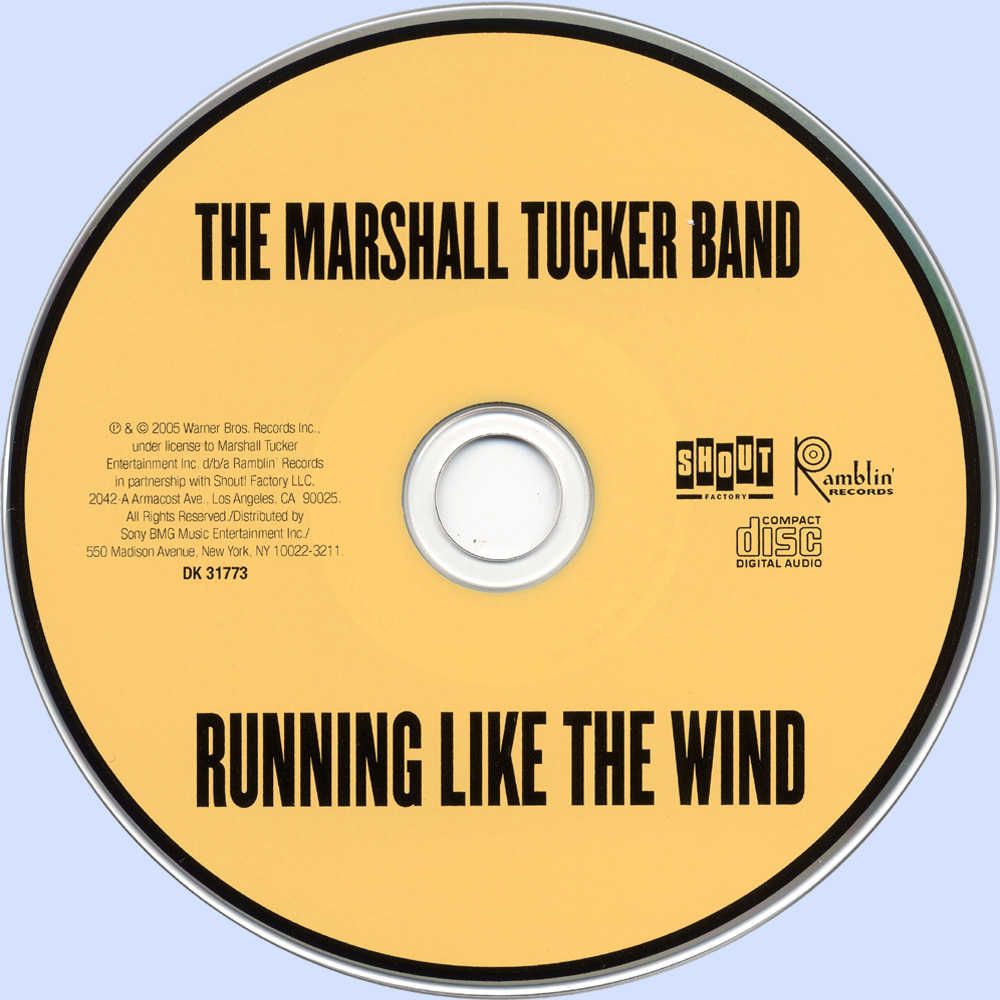
After the collapse of their record label, Capricorn, Marshall Tucker Band jumped to Warner Bros. The band's first album for their new home found them refining their blend of rock, country, R&B and jazz on a set of songs that mostly deal with life on the road ("Running Like the Wind") as well as the wives and girlfriends left behind ("Melody Ann," "My Best Friend"). In all, it’s probably Marshall Tucker Band's most bittersweet album, and it connected with fans, who made it a To 30 album.
Tracks
1. Running Like The Wind (Toy Caldwell) - 9:10
2. Last Of The Singing Cowboys (George McCorkle) - 4:16
The reissuing of a record is not just news for the record, it’s also a reissuing of that part of the life of the listener who knew the original. Thus it is with Richard Clapton, his debut album Prussian Blue and me. Clapton is about to send into the world anew the album Prussian Blue along with Goodbye Tiger and The Great Escape.
And in this rebirth, there rises memories like mist on the lake for myself. It was 1973 and I was a teenager just awakening to music. It was not quite like the scene in Almost Famous when William Miller’s sister Anita bequeaths her albums to him when she leaves home. But for a young Newcastle lad there were mysteries within the record sleeves, more mysteries in a gatefold, of course and a triple album? Good lord. And there was wonder.
It is here that I thank David Jones for its records section and those half bubble listening booths. Looking back I’m sure whoever was the buyer for the store had not really a clue about the music they were supplying. Bless them. Among the top 10 chartbusters in the racks was an array of music unknown to the radio stations nor I would offer a guess most of the public. How else to explain Tony Orlando and Dawn (Tie a Yellow Ribbon Round the Old Oak Tree) next to Lynyrd Skynrd (Pronounced Leh-nerd Skin-nerd). I bought the latter. Or Pink Floyd’s Dark Side of the Moon next to Frank Zappa’s Overnite Sensation? I bought the latter.
I’ll admit a cover could be enough to persuade a young McFadyen to part with his $5.95. I took Supertramp’s debut album Crime of the Century (admittedly in 1974) into the half bubble, purely on the ultra-cool cover art of a pair of hands gripping cell bars in space, listened to it, was in turn gripped by it and bought it instantly (I like to think I was the one of the first in the country to buy it.) I did the same with Emerson, Lake and Palmer’s Brain Salad Surgery, after having bought its predecessor Trilogy purely on its cover - and then spent countless hours trying to work out what it meant.
And so it was in 1973. The half bubble listening booth was the portal into the music of Richard Clapton. At a time when a driver in the mark of success of pop music in this country was to sound like an American, Clapton was a burst of fresh air. Here was an Australian singing in an unadorned Australian accent. He was singing of the heart and the street. He was singing from just 100 miles away and I could hear in his voice that he was singing to me. That is a mark of music transcending. I played the record to death.
Not quite. I still have it. And it has Clapton’s signature on it, too. (When I interviewed him, like the fan from decades earlier, I took the album with me.) People are now asking more than $1000 for an original pressing. Mine’s not for sale.
Prussian Blue is a time capsule. In 1973, the world was school, sport, family and friends. Life was generally smooth waters that was barely disturbed from a gust of the affairs of the wider world. To listen to the album these days takes me back to a place and time before I stepped out into that world.
Clapton’s voice then was more nasally and reedier than what it became down his career. It was the green reed bending with rhythm of the lyrics and melodies. And what he was singing turned my head, opened my mind to the possibilities of art. On the title track Clapton sings that he feels ‘like I’m in a Bunuel movie, right here at home/Surreal as Ornette Coleman’s saxophone/Playing on my broken gramophone/Oh baby, don’t you leave me here alone’.
Critics praised the album, which contained songs written while he was travelling in Europe. Due to grass-roots support, Prussian Blue sold steadily and four years later it was still selling 200-500 copies per week. The album has long been out of print with original copies of the first pressing on vinyl selling in the secondary market for a small fortune.
Memphis, despite it's authentic blues heritage, gave birth to a number of great rock acts that are still remembered with great affection, despite the fact that they may not have topped the national or, indeed, international charts. Chief amongst them were Target and Creed. Two bands that gave it their all, recording for major labels and making a splash that still shake the foundations to this day. For Creed the road to recognition was, like most acts of the era, strewn with disappointment, and difficulties that ultimately brought the band to it's knees, despite valiant attempts to overcome the obstacles. Signed to the prestigious Elektra/Asylum label () - home of the Eagles the band s initial prospects looked bright but progress would soon grind to a halt when they were paired with a country-pop producer who toned down the band's hard rock edge, looking to tame their sound and position them closer to the AOR style popular at the time. But the album didn't neuter their style completely, and leaves us in no doubt about the band's hard rock heart. It was a tough, lean and mean sound, sitting somewhere between the Southern rock style of Molly Hatchet and the raw punch of late '70s hard rock acts such as Aerosmith.
Tracks
1. Keep On Rockin' (Hal Butler, Luther Maben) - 3:21
2. Tied Down (Luther Maben, Steve Ingle, Tom Likes) - 3:25
3. Firecracker (Steve Ingle) - 4:01
4. You Never See It That Way (Hal Butler, Luther Maben) - 3:20
5. We're Gonna Make It (Hal Butler, Luther Maben) - 3:46
6. Just Can't Stop (Steve Ingle, Chip Thomas) - 4:05
7. Too Proud To Cry (Hal Butler, Luther Maben) - 3:15
8. Can't Find Love (Hal Butler) - 4:04
9. Time And Time Again (Hal Butler, Steve Ingle, Luther Maben) - 6:49
10.You Never See It That Way (Hal Butler, Steve Ingle, Luther Maben) - 3:41
11.We Need Ya (Hal Butler, Steve Ingle, Luther Maben) - 3:31
12.Crazy Woman (Hal Butler, Steve Ingle, Luther Maben) - 3:27
13.Can't Find Love (Hal Butler) - 3:52
14.Time And Time Again (Hal Butler, Steve Ingle, Luther Maben) - 8:25
15.Livin' In Dreams (Hal Butler, Steve Ingle, Luther Maben) - 2:38
Chapter Three was more progressive and not commercially successful at the time. Slightly ahead of the times. Volume Two was originally released in 1970. The opener, "Lady Ace" is a haunting melody with and intricate rhythms. Standout tracks, "Poor Sad Sue" and the epic "Happy Being Me" which clocks in at over ten minutes and takes the listener on a journey through various moods and textures. The album closes with the haunting ballad "Virginia" leaving the listener feeling contemplative and fulfilled. "Volume Two" is a must-listen for fans of jazz-rock and anyone looking for a cerebral musical experience.
Tracks
1. Lady Ace - 8:00
2. I Ain't Laughing - 2:36
3. Poor Sad Sue - 5:56
4. Jump Before You Think - 4:52
5. It's Good to Be Alive (Brian Hugg, Manfred Mann) - 3:32
6. Happy Being Me - 15:55
7. Virginia (Manfred Mann) - 4:55
8. I Ain't Laughing - 2:36
9. Happy Being Me - 4:04
10.Virginia (Manfred Mann) - 3:39
All songs by Mike Hugg except where noted
Bonus Tracks 8-10
Manfred Mann Chapter Three
*Manfred Mann - Organ, Police Whistle, Arranger, Backing Vocals, Lead Vocals (Track 7)
*Mike Hugg - Piano, Lead Vocals
*Bernie Living - Alto Saxophone
*Steve York - Electric, Acoustic Bass
*Craig Collinge - Drums
*Brian John Hugg - Acoustic Guitar, Backing Vocals
Way-Out musical patterns, sometimes sounding like outer space sounds and then with brass blaring at you, and then going jazzy. Vocals are mouthed so you can't quite hear them, and the cacophony is ragged and untidy, as if everyone is playing their bit regardless of the others or the whole.
But then the original Manfreds here Mann and Hugg-say "(This) represents in general what we personally have been waiting to do for some years."
Mike Hugg takes the vocals (sounds a bit like Peter Lorre) and plays piano, deserting the drums, which are played by Craig Collinge. Manfred is on organ and Bernie Living on alto-flute, while Steve York is on bass guitar. Other musicians are brought in as needed, plus Madeline Bell, Sue and Sonny, trumpet soloist Harold Beckett, and guitarist Brian Hugg. Mann and Hugg wrote all 11 titles.
Manfred puts his voice through a distortion for One Way Glass, and Mike plays wistful piano on Where Am I Going. If you like your music weirdo, this is for you. Other titles: Travelling Man, Snake- skin Garter, Konekul, Sometimes, Devil Woman, Time, Mister You're A Better Man Than 1. Ain't It Sad. A Study in Inaccuracy.
by Allen Evans, NME, October 1969
1969's "Manfred Mann Chapter Three", is light years from the airy pop of "Do Wah Diddy Diddy," recorded by the hit-making first group formed by South African Manfred Mann and Mike Hugg in 1963. This is as much jazz as rock. There's hardly any guitar, but a swaggering horn section compensates. Imagine a darker, moodier Traffic with Mann manning the organ instead of Steve Winwood. Hugg's raspy vocals are featured on the first album recorded with the new band. The standout tracks are the album-opening "Travelling Lady" and "Time," but they are hardly the only strong ones.
by Mark Allan
Tracks
1. Travelling Lady (Manfred Mann, Mike Hugg) - 5:50
2. Snakeskin Garter - 5:50
3. Konekuf (Manfred Mann) - 6:01
4. Sometimes - 2:42
5. Devil Woman - 5:28
6. Time - 7:34
7. One Way Glass (Manfred Mann) - 3:35
8. Mister You're A Better Man Than I (Manfred Mann, Mike Hugg) - 5:13
9. Ain't It Sad - 2:00
10.A Study In Inaccuracy (Manfred Mann) - 4:09
11.Where Am I Going - 2:51
12.Sometimes - 2:26
13.Mother - Aka Travelling Lady (Manfred Mann, Mike Hugg) - 5:23
14.Devil Woman - 5:26
15.A Study In Inaccuracy (Manfred Mann) - 5:18
Sond written by Mike Hugg except where stated
Bonus Tracks 12-15
Manfred Mann Chapter Three
*Manfred Mann - Organ, Police Whistle, Arranger, Backing Vocals, Lead Vocals (Track 7)
Rare 1969 album on the Texas Revolution label, recorded by a project featuring producer, vocalist and percussionist Linden Hudson. The LP was the result of long jam sessions. Most notable ingredient arguably is the acid guitar of Ted Hawley, showcasing a blues vibe that reminds of Moving Sidewalk-era Billy Gibbons. 'A Meat Music Sampler' rates as one of the best kept secrets of late '60s/early '70s US underground rock.
Long a fan favorite, Man's fourth studio album was recorded in 1971 during a harried one-week studio session that found the group having to write nearly the entire album, barring the tight and rocking "Angel Easy" and the group's multi-part masterwork "Many Are Called but Few Get Up." Frankly, the album sounds like a record that was largely jammed in the studio; the eight-minute-plus jams that close each side, "We're Only Children" and "Love Your Life," are particularly tiresome, good instrumental and lyrical ideas stretched well past their breaking points. However, besides the superior "Angel Easy" and "Many Are Called but Few Get Up," the album does include the rather wonderful "All Good Clean Fun," a showcase for pianist Clive John and lead guitarist Deke Leonard that has a delightful prog pop playfulness akin to some of Genesis' more lighthearted early moments or the daffiness of the later band Hatfield & the North.
by Stewart Mason
Tracks
1. Angel Easy - 5:02
2. All Good Clean Fun - 4:34
3. We're Only Children - 8:30
4. Many Are Called, But Few Get Up - 7:26
5. Manillo - 5:17
6. Love Your Life - 8:59
7. Many Are Called, But Few Get Up - 8:55
8. Angel Easy - 5:06
9. Romain - 18:32
All compositions by Martin Ace, Clive John, Michael Jones, Deke Leonard, Terry Williams
Bonus Tracks 7-9 recorded Live at Grugahalle, Essen, Germany
Voudouris & Kahne a duo consisting of Roger Voudouris and David Kahne, with Roger on guitar and vocals and David on keyboards and vocals.
They have released two albums, “There's A Secret Goin' On” (1975) and “Street Player” (1976). Here we have both albums on CD from Vivid Sound in Japan in 2000, but both albums are now hard to find.
Roger Voudouris, born in Sacramento, California, USA on December 29, 1954. In 1978, Roger Voudouris started as a solo artist under Warner Bros label and released the album “Roger Voudouris”. In 1979 Roger Voudouris his second solo album “Radio Dream” were released, and from this album the song “Get Used To It” gave him his first Billboard Top 30 hits. With these two album Roger Voudouris got established as a west coast american rock musician and followed to release album in this music style backed up by great session musicians such as: Jay Graydon, Michael Omartian, Jeff Porcaro, Neil Stubenhaus, Tom Scott, Jerry Hay, Jim Horn, Richard Page, Steve George and others.
Two albums followed: “A Guy Like Me” (1980) and “On The Heels Of Love” (1981) and Roger Voudouris got established as an artist in Japan also. Most of his albums has been re-released in the 90´s on Japanese labels. Roger Voudouris passed away on August 3rd, 2003.
The title track, “Street Player. It is a funky and groovy number with a sharp performance and Roger's wild and passionate vocals. Backing musicians include Chuck Domanico (b), James Gadson (ds), and Bobby Hall (perc). Saxophone soloist Mike Butera, who also played on the first album, is a lively soloist, and his performance fits the title of the song “Street Player” perfectly. Wonder Of Wonders” is sweet pop soul. Roger's vocals are gentle and soulful.
It Will Happen With Us” is a refreshing, sweet and sour acoustic number. The skilled performance is softly enveloped by delicate strings, creating a pleasant sound. Arranged by David Kahne, who also arranged all the songs on this album, “Were You Alone Last Night” shows a jazzy flavor, and the album has a lot to offer.
Producer Michael Stewart is known for his work on Billy Joel's “Piano Man” (1973) and “Streetlife Serenade” (1974), and on the AOR side he has produced albums by Kenny Rankin, Randy Edelman, Evie Sands, and others. In the AOR field, he produced albums by Kenny Rankin, Randy Edelman, Evie Sands, and others.
David Kahne began his music industry career as an artist signed to Capitol Records. He then began working as independent producer/engineer in the San Francisco Bay area, working with seminal underground bands like Romeo Void, Rank and File, and Pearl Harbor & the Explosions. In 1983, he began a long tenure at Columbia Records, serving 8 years as a Staff Producer before being named Senior Vice-President of A&R in 1991. While at the company, he produced and arranged for a wide range of artists including Tony Bennett, The Bangles, Fishbone, Presidents of the United States of America, Billy Joel, Dionne Ferris, Shawn Colvin, and Bruce Springsteen.
David left Columbia in 1995 and returned to independent production, producing albums for, among others, Sublime, Soul Coughing, and Sugar Ray.
In 1998, David was named Senior Vice-President of A&R for Reprise Records, and in 2000 he was named Executive Vice-President of A&R for Warner Bros. Records. During his tenure there, he produced Orgy, Chris Isaak, Stevie Nicks, KD Lang, and New Order, among other artists.
In 2002, David left Warners to return to independent production. He has produced many projects, including Paul McCartney, The Strokes, Regina Spektor, Sean Lennon, Reeve Carney, Butterfly, Kelly Clarkson, Matisyahu, Taking Back Sunday, and Renee Fleming.
David is also a composer of orchestral music, having written 3 full-length ballets and composing for film, including the score for the Dublin-produced "Bloom", a film adaptation of Joyce's "Ullyses" starring Stephen Rea. He also co-wrote a piece for Twyla Tharp, "Surfer at the River Styx" with Don Knaack. David has his own studio, SeeSquared Studios, situated at Avatar Studios, where he does most of his production work.
Tracks
1. Street Player - 3:06
2. Wonder Of Wonders - 3:30
3. It Happen With Us - 3:26
4. Were You Alone Last Night - 4:33
5. Monterey - 4:36
6. Our Song - 3:42
7. Flamingo Sky - 4:45
8. Ladies In Mercedes - 3:05
9. Are You Willing? - 3:35
10.Endings - 5:04
11.There's A Secret Goin' On - 3:19
12.Lying To Me You - 3:17
13.Take Your Music To The People - 3:26
14.Good Friend Of Mine - 3:20
15.Run Eddie Run - 5:05
16.I Only Wanted To Know Your Name - 3:50
17.Time Is Love - 2:49
18.Sidney - 2:51
19.Beautiful Love Between Beautiful People - 4:12
20.Rock Me Baby - 3:31
21.I'll Come Ridin' - 3:56
Music and Lyrics by Roger Voudouris, David Kahne
Tracks 1-10 from 1976 "Street Player" LP
Tracks 11-21 from 1975 "There's A Secret Goin' On" LP
Musicians
*Roger Voudouris - Acoustic, Electric Guitars, Vocals