The bands on this selection represent the innovative boiling point of the short-lived worldwide psychedelic rock movement between 1967-71, the years when garage punk evolved into heavy psychedelic rock with its wider soundscapes and complex improvisations. Vol. 1 contains a dozen 45-rpm songs by lost psychedelic messengers (8 US bands, one from Germany, Peru and France). The groups are Blackrock, Sound Machine, Yesterday/s Obsession, Mastermind, Sangre Mexicana, Bhagavad Gita, Protein Bros, Purple Canteen, Los Nuevos Shains, Blow Mind and the A & B-side of legendary Dirty Filthy Mud. About half of the songs are previously unreissued and appear in stunning soundquality and with 12 p. poster-booklet.
Artists - Title - Composer
1. Blackrock - Black Cloud Overhead (Archie Turner, Cornell McFadden, Joseph Reynolds, Kirk Dudley, Willie Pettis) - 3.36
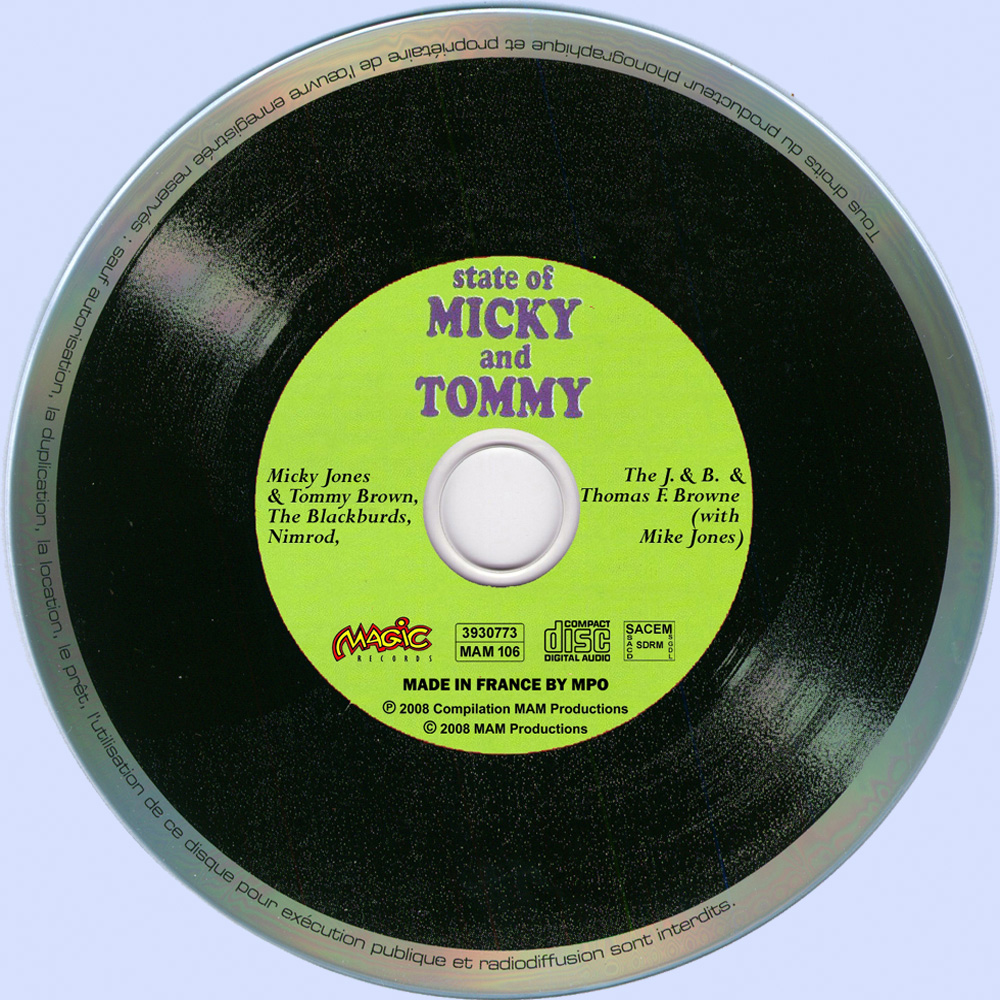
It's not well known, but long before he joined Foreigner -- and even before he was in Spooky Tooth -- Mick Jones made quite a few records with Tommy Brown, the pair working in France for much of the period. This French CD collects 24 tracks in which they were involved between 1965 and 1971, encompassing recordings billed to several different monikers, including the State of Mickey & Tommy, the Blackburds, Nimrod, the J&B, and Thomas F. Browne. It may be that the singles they released as the State of Mickey & Tommy, obscure as those 45s are, are the best known of the lot, especially "With Love from One to Five," which has shown up on a few relatively high-profile U.K. psychedelia compilations. That does happen to be one of the better numbers, but generally this CD has fair, though not exceptional, music that reflects the British mod, pop/rock, and psychedelic trends of the time with occasional hints of French and Continental influences. "With Love from One to Five" is typical if classy 1967 orchestrated psychedelic pop; "Nobody Knows Where You've Been" strongly recalls the arrangements on Sgt. Pepper's cuts like "Within You, Without You"; and "Frisco Bay" is nice dainty, dreamy pop with beatific Summer of Love lyrics and the lightest hints of raga-rock.
All of those songs were found on singles credited to the State of Mickey & Tommy; the ones billed to the Blackburds are more like soul-flavored British mod rock that could serve as incidental film music, while Nimrod's 1969 single "The Bird" (previously included on several collector-oriented comps of rare British psychedelia) is a fairly strong relic bridging psychedelia with early progressive rock. The best track, however, is the relatively unheralded 1966 single "There She Goes" by the J&B, a quite haunting, dramatic song that's a bit like a mini-soundtrack to a story of Swinging London heartbreak. As a whole, this will hardly qualify Jones and Brown as lost masters of mid- to late-'60s British rock, but there's pleasant period music of the genre to be heard, virtually all of it from extremely rare recordings (including soundtracks).
by Richie Unterberger
Tracks
1. With Love From 1 To 5 - 3:01
2. Sunday's Leaving - 2:43
3. I know What I Would Do - 3:06
4. Quelqu'un Qui Part (Mick Jones, Tommy Brown, Long Chris) - 2:36
5. Frisco Bay - 3:14
6. Julian Waites - 2:24
7. Nobody Knows Where You've Been - 2:40
8. Good Time Music (John Sebastian) - 2:56
9. If I Could Be Shure - 3:11
10.Alice - 2:48
11.Promenade Dans La Foret Du Brabant (Mick Jones, Tommy Brown, Giorgio Gomelsky) - 2:19
12.Absolument Hyde Park (Mick Jones, Tommy Brown, Raymond Donnez) - 3:10
13.Get Out Of My Life Woman (Allen Toussaint) - 2:43
14.Don't Go Home (Johnny Lehmann, Stan Lebowsky) - 1:59
15.In The Crowd (Billy Page) - 2:49
16.Don't Need Nobody - 3:24
17.The Bird - 3:16
18.Don't Let It Get The Best Of You - 2:23
19.There She Goes (Mick Jones, Tommy Brown, Gilles Thibaut) - 2:39
20.Wow! Wow! Wow! (Mick Jones, Tommy Brown, Georges Aber) - 2:43
21.Never At All (Eddie Vartan, Tommy Brown) - 2:22
22.Then You Got Everything (Eddie Vartan, Tommy Brown) - 1:52
23.Gentle Sarah - 2:54
24.Carry My Load - 4:14
All songs written by Mick Jones, Tommy Brown except where noted
When the original LP by Synanthesia was released in the late sixties, the album cover gave no information about the band: sleeve notes had already become a thing of the past. Happily, the 2006 re-release on CD includes a little booklet which explains a little bit more about Synanthesia, how it came together, and what the group was trying to do.
The late sixties were a time of change in the pop music scene in England. The beat period of the early sixties, when a specifically English beat sound emerged to dominate pop music, came to a close. During the mid-sixties, after the release of the Beatles' Sgt. Pepper album, itself the culmination of more original ideas flowing into the Beatles' music, flower power took over. This started a wealth of new groups (or as they started to be called, bands), some of whom departed from rock-and-roll and beat, some leaning more towards folk and jazz. At the time, this music became labelled "underground" or "progressive". Among the most successful at that time were bands such as Jethro Tull, Pink Floyd, the Moody Blues, and King Crimson. Three-guitar-and-drums groups gave way to more varied instrumentation, with the introduction of wind instruments, especially sax and flute, and, to a lesser extent, strings.
London had become the centre of a new-style folk scene. Bob Dylan had introduced the idea of the singer-songwriter and inspired a whole range of this kind of artist in London, notably Bert Jansch (later to team up with John Renbourn in the acoustic band Pentangle) and another visitor from America, Paul Simon. The doors were open to music which was original, breaking away from the standard formulas of yesterday. Outstanding in originality was the Incredible String Band. Playing a multitude of instruments, the two musicians in that band, Robin Williamson and Mike Heron, drew on all sorts of different traditions, from Scotland to Afghanistan. The music was poetic and romantic. In the sixties, we allowed ourselves to dream.
In 1968 I started working in the small ad section at Melody Maker, at that time London's leading music newspaper. The paper went to press on Tuesday and Monday mornings always saw a never-ending procession of people coming to the office to place last-minute ads, looking for gigs, musicians, etc. Like many bands at that time, Synanthesia came together through the small-ad columns of Melody Maker. Dennis Homes, who brought the three of us together, placed an unusually long advertisement under "Musicians Wanted". What was he looking for? A second guitarist and a flute-player. Unusually, he listed all his musical preferences. I noticed that he was living in the same unfashionable part of London as I was: the working-class East End. We met.
Dennis had already been in the music scene for quite some time, playing bass guitar in a soul band. He played me some of his original songs and I was struck by their complexity and unusual quality (and the fact that they had nothing to do with soul music). I remember him saying that he was interested in doing something really different. Only 18, I was then more or less a beginner on the guitar, but already had a distinct preference for acoustic fingerstyle playing. At that time the only things I could play, like many other players at that time, were songs I had learned listening to records (in those days the more interesting ones were harder to find and much more expensive!) and trying to work out what how the guitarist was getting his sound. I had also started to make up some songs of my own, initially very influenced by the style of Bert Jansch. In this I was inspired by Richard Carlton, a schoolfriend who taught me how to read music and who composed two of the tunes included on the Synanthesia LP.
The third member of the band was Jim Fraser. Jim was from the North of England and had just arrived in London. Unlike us, he was a jazzman through and through and had spent many a night blowing away in jazz sessions. He had an amazing gift for tasteful flute, sax and oboe improvisation around the tunes that Dennis and I played to him. With me on vocals and guitar, Dennis added his guitar or vibraphone, an instrument completely unheard of in "progressive" music. With Dennis on guitar and vocals, I accompanied on guitar or bongos and even ventured out on violin and mandolin.
We set out to be an acoustic band. We recorded a demo and Dennis hawked it around. This resulted in interest from an agency, Chrysalis (later to become a huge record label), and led on to gigs, mostly at colleges and universities. The setting in which we presented our music was not always the ideal one for us. Most of the other groups were amplified and loud. We played music which needed to be listened to: the aim was not to blow people over with a wall of sound. Still, it was an interesting experience.
After one concert, our agent told us that a guy was interested in recording us. The following Monday we were to go to a recording studio in Chelsea, a fashionable part of London. Another interesting experience. A visit to the toilet revealed a part of the studio with shelves stacked with master tapes by musicians I admired: the Incredible String Band, for example. I recall that at our second session (we only did two for the whole album!) we saw the gear that Fairport Convention had left lying around.
The album completed, we had to wait for its release. This proved more difficult. None of the record companies seemed to be interested. It was only after a long wait that we were signed up to RCA and the record came out. Unfortunately, RCA was not prepared to invest much in getting the public's attention. In those days, when the Home Service had recently been re-named Radio 1, local radio was in its infancy. Practically the only way of getting a hearing for our kind of music was by being invited to appear on Top Gear, John Peel's radio programme. We were not invited.
And so, the Synanthesia album flopped. The inevitable followed: we disbanded. It was impossible to keep on doing gigs in faraway towns and continue our day jobs. But we all needed the income from our day jobs.
Over the years, various friends reported that they had seen the Synanthesia LP on sale for 50p at Woolworth. It was only this year, 37 years later, that I suddenly heard the record was being sold on E-Bay for surprisingly large sums of money, that some time ago there had been a bad quality bootleg version, and that Sunbeam Records had been in touch with Dennis about a re-release. And that also, even more unexpectedly, one of the songs from our one and only album had been included on an anthology of British Folk music, called Anthems in Eden, on the Sanctuary label. This is very gratifying, especially in view of the fact that the other artists on that collection include many of those who influenced us.
One big plus about all this is that the three of us are now back in touch. Dennis tells me that up to the end of March 2006, the Synanthesia CD has already sold 632 copies. Not enough for platinum, but also not bad for a 37-year-old album.
by Les Cook, 2006
Tracks
1. Minerva - 4:15
2. Peek Strangely And Worried Evening (Les Cook) - 2:47
3. Morpheus - 5:51
4. Trafalgar Square (Les Cook, Richard Carlton) - 3:02
5. Fates - 2:02
6. The Tale Of The Spider And The Fly (Les Cook) - 5:58
7. Vesta - 4:45
8. Rolling And Tumbling (Les Cook, Richard Carlton) - 3:14
9. Mnemosyne - 5:20
10.Aurora - 3:50
11.Just As The Curtain Finally Falls (Les Cook) - 5:01
'Vivariatum' is the third album to be released by this Kent based group and spans the entire period of their career from 1970 - 77. It also features several other musicians who were a part of the Fantasy story whose contributions are finally acknowledged on this disc for the very first time, we delve back to the embryonic stages of the band, when they were known as Chapel Farm. This name was chosen because the band rehearsed at the farmhouse of the same name, the home of Paul Petley, their first singer.
The four songs, recorded by Chapel Farm in 1970, are all featured on this CD, having been lifted in their raw state from the only known surviving acetate and remastered, using the Cedar de-clicking sound system. These early demos feature the band's original vocalist, Paul Petley, whose gritty and rasping vocals difered markedly from those of Paul Lawrence who replaced him the following year. Also featured in this ensemble is Geoff Whitehorn, the band's original guitarist, who wrote the opening track presented here, 'Fire-Fire'. He also co-wrote 'Afterthought', a later version of which appears on 'Beyond The Beyond'.
The remaining Chapel Farm demos 'Vacuum'and 'Alone' were written by bassist and founder member, David Read, whose riving force and motivating influence is prominent throughout. Keyboards are handled by another founder member, David Metcalfe, whose penetrating Farfisa organ gives resonance to the overall sound. Brian Chatham was the band's first drummer, soon to give way to Jon Webster when the group moved residence from Chapel Farm to David Read's basement.
These four demos, which have been paired up to open and close proceedings here, give a valuable insight into how the band's music evolved from that early period into the more refined and recognizable sound that became synonymous with the complex yet often simplistic beauty of Fantasy's songs and musicianship. Of particular interest is the original version of 'Afterthought', where a direct comparison can be made between 'new' and 'old'.
In contrast with these primitive yet potent early demos are the six songs recorded by the re-formed Fantasy, some two years after 'Beyond The Beyond' was aborted. The musicians concerned are Paul Lawrence (vocals), David Read (bass), Geoff Whitehorn, who returned to the fold to play guitar, and Nick and Malcolm Page (piano and drums respectively). These rare recordings, all of which have remained unreleased until now, capture Fantasy in relaxed mood, exploring diferent musical styles whilst retaining that special 'Fantasy' sound. The understated approach of these compositions harks back to the melancholy feel of some of the more mellow songs on 'Paint A Picture'. Paul Lawrence's ability to turn a song into something special is evident throughout with his unique phrasing and heartfelt lyrics. His gift for being able to say a lot with a few well chosen words is portrayed beautifully by 'In My Life' and 'Angel'. This is greatly enhanced by the sympathetic guitar playing of Geoff Whitehorn which has developed in parallel to change the appeal of the later tracks.
With the lighthearted 'Low Love' the band adopt a more commercial approach. The song has a lovely groove to it conjuring up a picture of romance on sun drenched beaches by the sea. Sandwiched in the middle of the eleven songs here, and included as a bonus, is the B side of Fantasy's elusive single from 1973. 'I Was Once Aware' reflects the general mood of much of the later material making it a perfect addition. 'Vivariatum' can be seen as an album of contrasts with its display showing the quantum leap from the hopeful and heady days of the early years to the mature and satisfying sounds of the final chapter. More importantly the diverse talents of the individual members that made up this remarkable group are captured here for all to savour.
by Pete Sarfas, 1994
Tracks
1. Fire-Fire (Geoff Whitehorn) - 6.41
2. Vacuum (David Read) - 4.03
3. In My Life - 3.56
4. Low Love - 4.26
5. Stardrifting - 4.32
6. I Was Once Aware (David Read, Paul Lawrence, David Metcalfe) - 3.30)
7. Could It Be Forever - 3.55
8. Fantasy Moods - 4.11
9. Angel - 3.24
10. Alone (David Read) - 4.31
11. Afterthought (David Read, Geoff Whitehorn, David Metcalfe) - 7.26)
All compositions by Paul Lawrence, David Read except where stated
Tracks 1,2,10,11 recorded in 1970 as Chapel Farm
Tracks 3,4,5,7,8,9 recorded in 1976
Track 6 recorded in 1973 b-side single (Politely Insane)
Best known for their classic Garden Shed, England will forever be remembered as one of the few "new" bands of the late 70s United Kingdom brave enough to make unadulterated, symphonic prog (on a major label, no less) at the height of punk. The Last of the Jubblies consists of demo recordings made after the band found themselves without a label when Garden Shed bombed commercially. The line-up is the same as Garden Shed except for bass player Martin Henderson, replaced by Geoff "Jaffa" Peckham.
There is a lot more emphasis here on long, instrumental passages than on the first album. Also, they seem to be turning away from the bright, sunny melodics that characterized songs such as "Three Piece Suite" and "Paraffinalea," moving into darker territory they began first to explore on "Poisoned Youth." This may or may not sit well with fans of the first album. In any case, the music is still of high quality, making The Last of the Jubblies a worthwhile progressive rock artifact from this dark period in prog-rock history.
Defiantly cast in the shadow of the then-recently defunct Nice, but brimming with their own ideas and imagination, Beggars Opera emerged in 1970 with a debut album that still stands as one of the crown jewels of prog. Five tracks long in its original (Vertigo label) form, but bolstered with both sides of their debut single for the Repertoire CD, Act One is an audacious blending of hard riffs, Heep-esque vocals, and crazed organ and Mellotron, and it's those latter elements that most distinctly flavor the album.
The opening "Poet and Peasant," based on Franz Von Suppe's overture of the same name, sets the scene with its multiple shifts in tone and tempo; the same composer's "Light Cavalry" then closes the disc in similarly dramatic style. "Raymond's Road" is the climax, however. An 11-minute orgy of sound that rides a "Rondo" rhythm, then sets a slew of classical snatches dancing above it. It's a breathtaking effort, a cross between a mad medley and a free festival freakout that so firmly establishes Beggars Opera's credentials that it seems impossible to believe that things never got any better for them.
by Dave Thompson
Tracks
1. Poet And Peasant (Franz von Suppé, Arranged By Beggars Opera) - 7:11
2. Passacaglia (Marshall Erskine, Virginia Scott) - 7:04
3. Memory (Marshall Erskine, Virginia Scott) - 3:56
4. Raymond's Road (Martin Griffiths, Marshall Erskine, Ricky Gardiner, Alan Park, Raymond Wilson) - 11:49
5. Light Cavalry (Franz von Suppé, Arranged By Beggars Opera) - 11:55
6. Sarabande (Martin Griffiths, Marshall Erskine, Ricky Gardiner, Alan Park, Raymond Wilson) - 3:32
If you like this band just a little bit, I am 99% certain you have one of the issues of Garden Shed. This album was recorded in late 1976. During the same sessions, the band had recorded a track called Nanagram which was released as the B-side of Paraffinalea in February 1977, shortly before the album was released.
The quality and musical importance of this album is undisputed. 1977, however, was a hard time for progressive rock, especially since the band broke-up not long after the album's release.
What I really love about this album, is that while it shows a certain level of complexity often compared to Yes, it is delivered in a way that is not so cold. The warmth of the symphonic side famously found in early Genesis makes it an album loved by fans of both those bands. Sitting between the styles of those big names, I really think this album will appeal to fans of both. Simply, if you like symphonic progressive rock, you have got to listen to this album. This has been a favourite among my collection ever since I heard it in the early 1980s. I have not met anyone who thought this album was "just OK".
And what about those bonus tracks? I admit to having a bit of chronology-based OCD, so I am having a bit of a problem here.
Before the Garden Shed album was recorded, the band had recorded two tracks at Olympic, which actually got them the deal to do the album. These tracks were Three Piece Suite (that would be used as a bonus track on some versions of this album), and Mister Meener which appeared on the next album (or Mister Meaner as it would appear on later issues for some reason). This Bandcamp version also contains just Three Piece Suite (Olympic). It's not too different from the album version, it really fits the rest of the album, and therefore is an excellent choice for a bonus track.
The 2005 reissue had Nanagram, another 2005 reissue had Three Piece Suite (Olympic), a 2008 reissue had both, a 2013 reissue had the latter plus a song called Destiny from a 2010 "taster" CD for the announced Box Of Circles album. Then in 2015 there was the Golden Edition on Green Tree Records, which had Nanagram and Three Piece Suite (Olympic) but also The Ladies' Valley from Webb's 2014 solo album Liquorish Allsorts, HeeBeeGeeBee from a 2016 various artists 4CD release called Decameron Ten Days in 100 Novellas Part 3, some different tracks from Box Of Circles, and finally a 2006 live version of Nanagram. My OCD is playing up.
The Bandcamp version contains the same bonus tracks as the 2015 release except for Carmina Burana. Including the version of Nanagram that was released as a single B-side is a no-brainer. Personally I would have selected Mister Meener as well and leave it at the complete 1976 recordings.
The difference in style is another indicator. The Box Of Circles album has a different musical style. England, but a modern version. An album in its own right. The tracks feel a bit out of place on this collection. The same applies to HeeBeeGeeBee, which is just too different. The live version of Nanagram is by a completely different band (except two), and 30 years after the original recordings.
I just have a hard time relating to a compilation of mostly unrelated tracks, just to fill a second disc. Especially since on a digital release you're not limited to disc lengths. But another aspect to digital releases, of course, is that I can just skip a few songs in a play-list. And what an album it is! Simply essential.
by Jerry van Kooten, Saturday 2 October 2021
Tracks
Disc 1
1. Midnight Madness - 6:55
2. All Alone - 1:52
3. Three Piece Suite - 12:57
4. Paraffinalea - 4:11
5. Yellow - 5:24
6. Poisoned Youth - 16:15
All compositons by Robert Webb, Martin Henderson, Jode Leigh, Frank Holland
Disc 2
1. Nanagram - 5:09
2. Carmina Burana (Carl Orff) - 4:00
3. Fags, Booze And Lottery - 4:47
4. The Ladies' Valley (Camille Saint-Saëns, Robert Web) - 7:42
5. Masters Of War (Bob Dylan) - 4:27
6. Three Piece Suite - 11:44
7. Heebeegeebee - 5:37
8. Nanagram - 4:15
All compositons by Robert Webb, Martin Henderson, Jode Leigh, Frank Holland except where indicated
Although Otis Spann will always be known as the piano player in the Muddy Waters Band, his solo work should not be overlooked. Possessing a beautifully expressive voice, Spann was also a facile songwriter, and freed of the restrictions inherent in a working electric blues band, his solo sides find him stretching out on piano as well. The Biggest Thing Since Colossus LP took place in January 1969 (there are a couple tracks here that date from late in 1968), a little over a year before Spann's death in 1970, and found him working with Blue Horizon label owner Mike Vernon and the Peter Green-era version of Fleetwood Mac (who Vernon managed). Spann is in fine voice here, delivering artful blues numbers that are just this side of jazz in execution, and the Fleetwood Mac boys are surprisingly sympathetic to it, making this a delightful release and one that no real fan of Spann should be without.
by Steve Leggett
Tracks
1. My Love Depends On You - 5:19
2. Walkin' - 2:51
3. It Was A Big Thing - 3:24
4. Temperature Is Rising (100.2°F) - 6:10
5. Dig You - 3:01
6. No More Doggin' (Jules Taub, Rosco Gordon) - 2:57
7. Ain't Nobody's Business (Clarence Williams, Porter Grainger, Robert Prince) - 5:12
Born as a beat music trio in 1964, Anonima Sound are mostly known for the presence, in the early years of their career, of a young Ivan Graziani; the latter left the group in 1970 for military service, and then undertook a long successful solo career. Until then, the band had released only four singles, without ever managing to record a full-length LP.
In 1971, only drummer Valerio Gualazzi was left from the original line-up; after the publication of another 45rpm, he re-established the band as Anonima Sound Ltd., with six new musicians. The following year, finally, the group released their first - and, eventually, their last - record, "Red Tape Machine", with Ivan Graziani playing bass guitar as a guest in two tracks.
The music of "Red Tape Machine" completely differs from the sound of the '60s, and is completely sung in English, thanks to the presence of the American Richard Ingersoll on vocals and flute. Although it shows a remarkable compositional maturity, the album is often neglected and underestimated, as it has always been associated with the Italian prog scene, to which it belongs to a minimal extent. Blues, west-coast and folk sounds intertwine in the eight tracks of the album, almost exclusively outlined by the acoustic guitar, whose riffs and arpeggios are accompanied by flute and electric guitar solos.
Chicago guitarist Jimmy Dawkins would have preferred to leave his longtime nickname "Fast Fingers" behind. It was always something of a stylistic misnomer anyway; Dawkins' West Side-styled guitar slashed and surged, but seldom burned with incendiary speed. Dawkins' blues were generally of the brooding, introspective variety -- he didn't engage in flashy pyrotechnics or outrageous showmanship.
It took a long time for Dawkins to progress from West Side fixture to nationally known recording artist. He rode a Greyhound bus out of Mississippi in 1955, dressing warmly to ward off the Windy City's infamous chill factor. Only trouble was, he arrived on a sweltering July day! Harpist Billy Boy Arnold offered the newcomer encouragement, and he eventually carved out a niche on the competitive West Side scene (his peers included Magic Sam and Luther Allison). Sam introduced Dawkins to Delmark Records boss Bob Koester. Fast Fingers, Dawkins' 1969 debut LP for Delmark.
by Bill Dahl
First released in 1969, after guitarist Jimmy Dawkins had served a long apprenticeship as a sideman in the Chicago electric blues scene, Fast Fingers remains one of the finest pure electric blues albums of its era. Dawkins proves to be a solid songwriter and an able singer, although the best moments on the album invariably come when he tears off a casually perfect, deeply soulful, but never showy electric solo. Highlights include the stomping instrumental "Triple Trebles," featuring an outstanding Dawkins solo over a funky horn-driven rhythm, and the mellow, laid-back opener, "It Serves Me Right to Suffer."
The album was finally reissued on CD in 1998 with a new cover and two fine outtakes from the original sessions, "Sad and Blues" (which features an exceptional extended solo by Dawkins) and "Back Home Blues," which is a 1969 recording with a new (1998) vocal by Dawkins.